
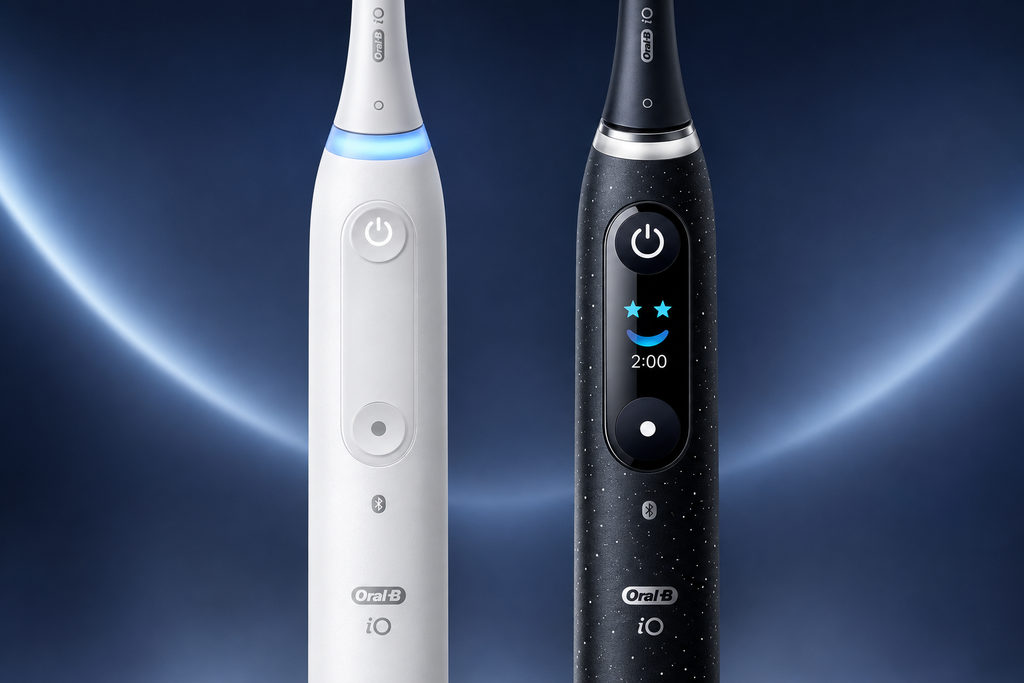
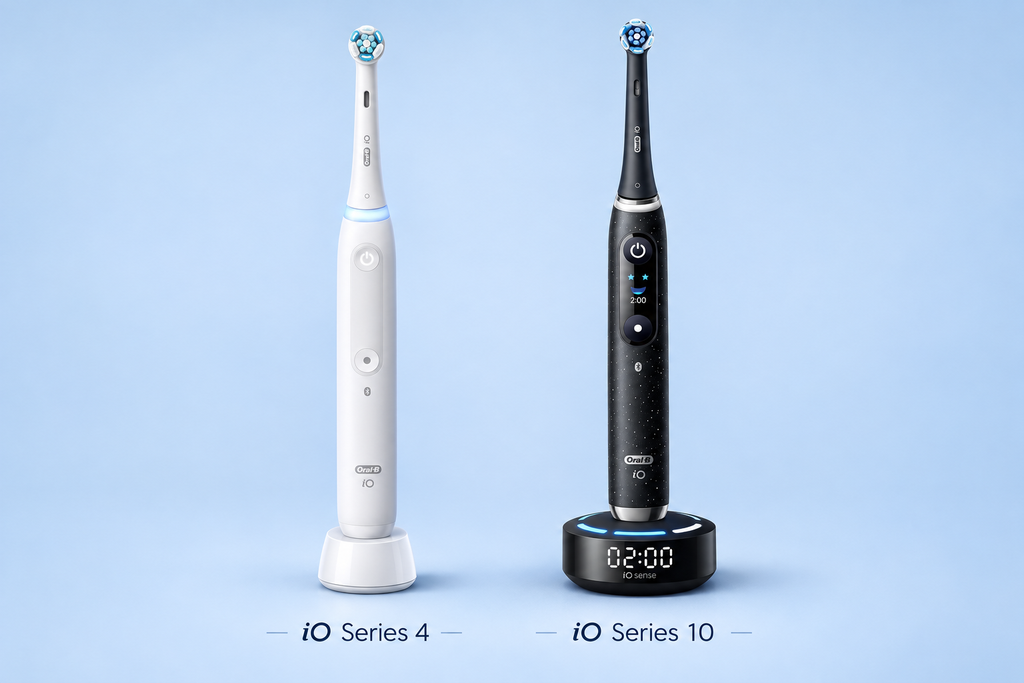
The Oral-B iO 4 vs 10 comparison puts two very different buying priorities side by side. The iO4 focuses on the essentials of the iO brushing experience at a lower price. The iO10 adds a color screen, more brushing modes, advanced tracking, faster charging, and the iO Sense smart charging base.
For most value-focused buyers, we would start with the Oral-B iO4. It already offers a round iO brush head, pressure feedback, a timer, and useful cleaning settings. We would choose the iO10 when its guidance and convenience features solve a specific problem in our routine, rather than assuming the higher model number guarantees better results.
There is also an important buying detail: iO4 listings are not completely consistent across generations and markets. Older connected versions advertise Bluetooth, while some newer US comparisons list the iO4 without app connectivity. We will explain what to check before ordering.
Oral-B iO4 vs iO10: Quick Comparison
| Feature | Oral-B iO Series 4 | Oral-B iO Series 10 |
|---|---|---|
| Main appeal | Core iO features at a lower cost | Premium guidance and convenience |
| Round iO brush head | Yes | Yes |
| Advertised modes | 4 | 7 |
| Interactive color screen | No | Yes |
| Visible pressure feedback | Yes | Yes |
| Two-minute timer | Yes | Yes |
| App connection | Offered on connected versions; verify exact unit | Yes |
| iO10-style 3D teeth tracking | No | Yes |
| iO Sense countertop guidance | No | Yes |
| Full recharge | About 12–16 hours in different manufacturer guidance; follow the supplied manual | About 3 hours with the appropriate fast charger |
| Replacement head family | Oral-B iO | Oral-B iO |
| Travel accessories | Often a basic case; verify bundle | Charging case in advertised premium kits; verify bundle |
The practical distinction is how much help we want around the brushing process. The iO4 keeps the experience relatively simple. The iO10 provides more information and more ways to access it, but we still need to decide whether those additions are worth the price difference.
What Do the Oral-B iO4 and iO10 Have in Common?
Both belong to the iO family and use its round-head cleaning approach, combining oscillating-rotating movement with micro-vibrations. Both offer timing assistance and visible pressure feedback. Buying the iO4 therefore does not mean buying a brush without the core features that define this range.
They also use the same iO replacement-head family. We do not need to buy the flagship handle simply to access compatible iO heads. That matters when deciding whether the initial saving on the iO4 comes with an obvious compromise in refill choice.
We would evaluate the extra features separately from the shared cleaning platform. A screen can make information clearer, and tracking can encourage a more deliberate routine. Neither feature automatically proves that a more expensive handle will produce better results for every user.

- Contents: electric toothbrush including 1 brush head (ultimate cleaning), charging travel case, replacement brush case, …
- Toothbrush coach with iO SENSE for real-time feedback on coverage, time and pressure – directly via the charging station…
- Practical on the go with charging travel case, 3H fast charging with magnetic charging station and battery status tracki…

- FOR HEALTHIER GUMS IN JUST 1 WEEK remove 100% more plaque and even 2.5X in between teeth* with ORAL-B MOST ADVANCED TECH…
- TRACK AND IMPROVE YOUR BRUSHING HABITS over time with ORAL-B APP through performance reports, journeys, and goals
- PROTECT YOUR GUMS WITH iO PRESSURE SENSOR, Oral-B's only one to signal if you are applying the PERFECT PRESSURE for an e…
Does the Oral-B iO10 Clean Better Than the iO4?
We would not describe the iO10 as delivering several times the cleaning ability of the iO4 just because it can cost several times as much. The higher price pays for a richer feature set, not a proportional increase in cleaning performance.
In particular, manufacturer claims comparing a toothbrush with a manual brush are not head-to-head evidence against another iO model. A plaque-removal percentage printed on one product page should not be compared casually with a different percentage on another page: the underlying tests and claims may differ.
Where the Premium Features Might Help
We can see a sensible case for the iO10 when someone wants reminders about coverage and will actually follow them. Its tracking and smart base may make a more attentive routine easier to maintain. That is a usability argument, rather than a promise of a particular clinical improvement.
Conversely, someone who already brushes carefully and dislikes digital coaching may gain little from those additions. We would rather choose a brush we will use comfortably and consistently than pay for features that become background decoration.
Four Brushing Modes vs Seven
The iO4’s familiar four-mode set covers Daily Clean, Sensitive, Super Sensitive, and Whitening. The iO10’s advertised seven-mode set adds Gum Care, Intense Clean, and Tongue Clean to those categories. Exact labels can vary slightly between product descriptions.
| Mode | iO4 | iO10 |
|---|---|---|
| Daily Clean | Yes | Yes |
| Sensitive | Yes | Yes |
| Super Sensitive | Yes | Yes |
| Whitening / Whiten | Yes | Yes |
| Gum Care | No dedicated mode in this set | Yes |
| Intense Clean | No | Yes |
| Tongue Clean | No | Yes |
Are the Extra Settings Worth Paying For?
We would ask which settings we expect to use regularly. If we normally choose Daily Clean or Sensitive, the iO4 already covers those preferences. Seven modes look impressive on a specification sheet, but unused modes do not make a purchase better value.
The iO10 becomes more attractive if a particular additional setting is important to us and we also want its other features. Paying a large premium for one mode alone is a less convincing argument than paying for a package of benefits we genuinely expect to use.
Some newer premium iO descriptions also mention Smart Adapt. We would confirm any such feature for the exact retail version rather than assuming that every earlier iO10 has the same software capabilities.
Handle Controls: Simple Buttons vs a Color Screen
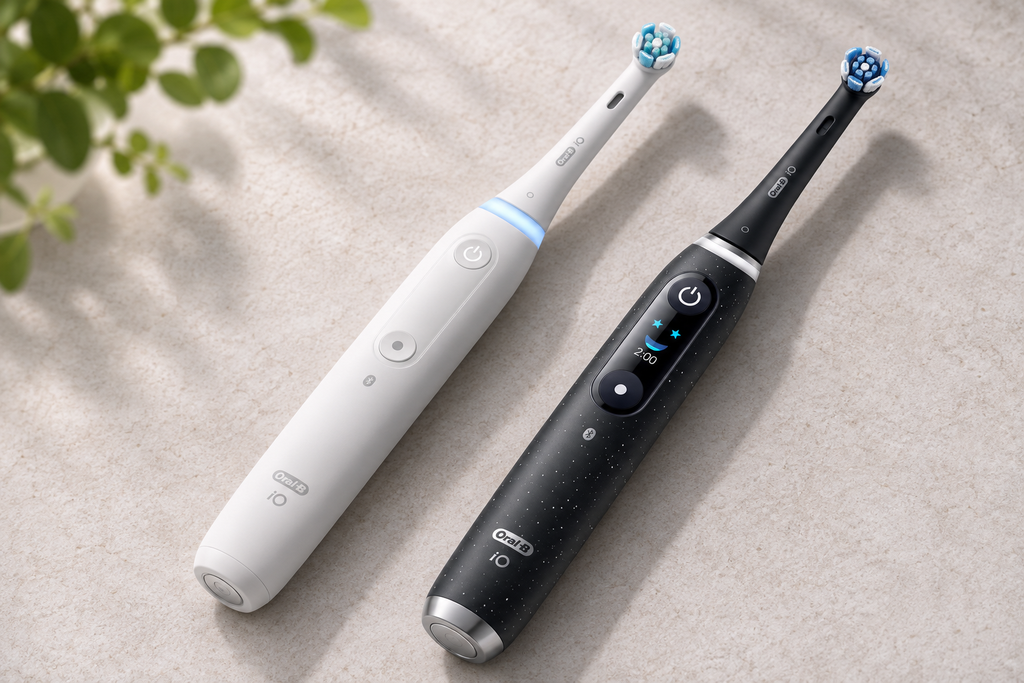
The iO4 does not have the interactive color display found on the iO10. Its controls and indicators provide a simpler interface. The iO10 gives us a screen for information such as mode selection, brushing time, and battery status.
This is a difference we may notice more frequently than the number of available modes. If we like seeing a setting identified clearly, the screen makes the premium brush easier to understand at a glance.
On the other hand, a simple interface can be perfectly adequate once we learn it. We would not consider the absence of a screen an automatic problem for someone who usually selects one preferred setting and leaves it there.
Which Interface Would We Prefer Day to Day?
For a person who enjoys information and regularly changes settings, we would favor the iO10 interface. For someone who wants a straightforward brushing routine with fewer things to look at, the iO4 is appealing.
We would also avoid confusing visual sophistication with durability. A nicer screen does not establish that the entire toothbrush will last longer, and a simpler handle does not prove that it will outlast the flagship. Neither conclusion follows from the feature list.
Pressure Sensors: The iO4 Already Has This Important Feature
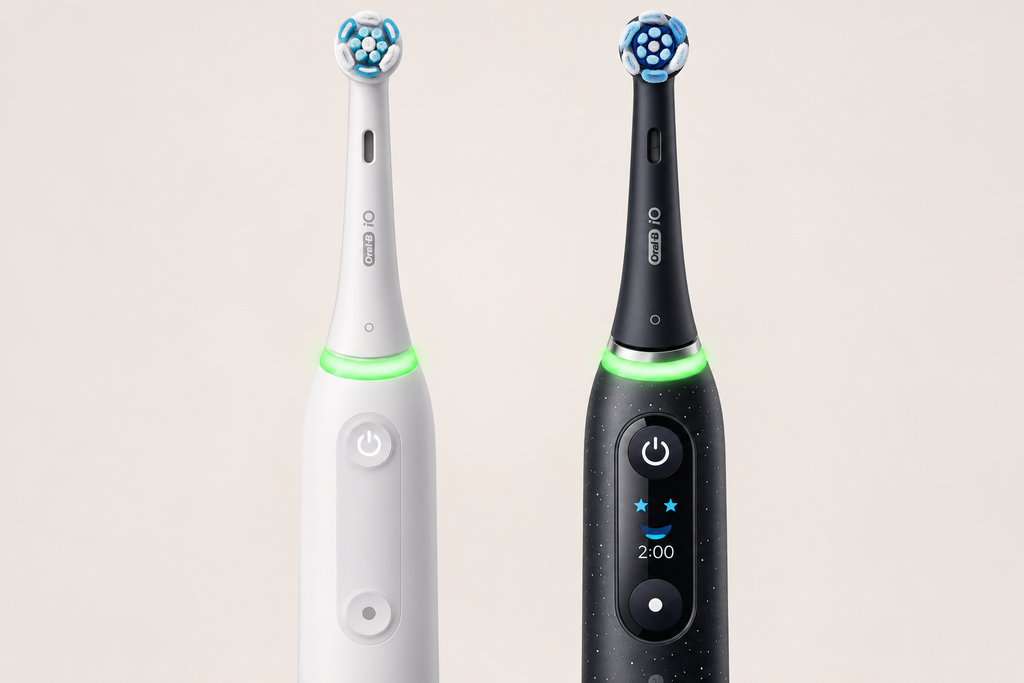
Both models offer visible pressure feedback. On the familiar versions, the light ring distinguishes excessive pressure, appropriate pressure, and insufficient pressure. We do not need to move to the iO10 simply to obtain a warning that we are pressing too hard.
The iO10 can also communicate pressure guidance through the iO Sense experience. That adds another place to receive information, but the underlying buying point remains: the iO4 is not missing pressure assistance.
If pressure feedback is our main reason for replacing an older toothbrush, we would begin by evaluating whether the iO4’s visible ring is easy for us to notice. It may already satisfy the requirement at a considerably lower purchase price.
Bluetooth and App Features: Check the Exact iO4 Version
This part of the comparison needs more care than a simple yes-or-no table. Established iO4 product listings advertise Bluetooth and app features such as brushing reports, goals, and habit tracking. Some newer US manufacturer comparison material, however, lists the iO4 without app connectivity.
We would therefore not promise that every iO4 currently sold connects to the app. If Bluetooth matters to us, we should verify it on the exact box, product code, and listing before purchasing. A retailer may use a familiar series name while selling a different revision from the one in an older review.
App Connection Is Not the Same as Advanced Tracking
A connected iO4 should not be assumed to offer the iO10’s full 3D teeth-tracking system. Basic session information and habit reports are different from detailed position-based coverage coaching.
We would choose the iO10 if advanced tracking is a central part of the purchase. If all we want is a brush that can operate independently, both models can be used for ordinary brushing without opening an app for every session.
What If We Never Use Toothbrush Apps?
Then the value case for the iO4 becomes stronger. We would not pay a substantial premium for detailed app information that we already know we will ignore.
The iO10 still has a separate argument in its favor: its smart base can provide guidance during brushing without requiring us to watch a phone. That is worth considering if we dislike phone apps but would appreciate visible reminders at the sink.
iO Sense: The iO10’s Standout Addition
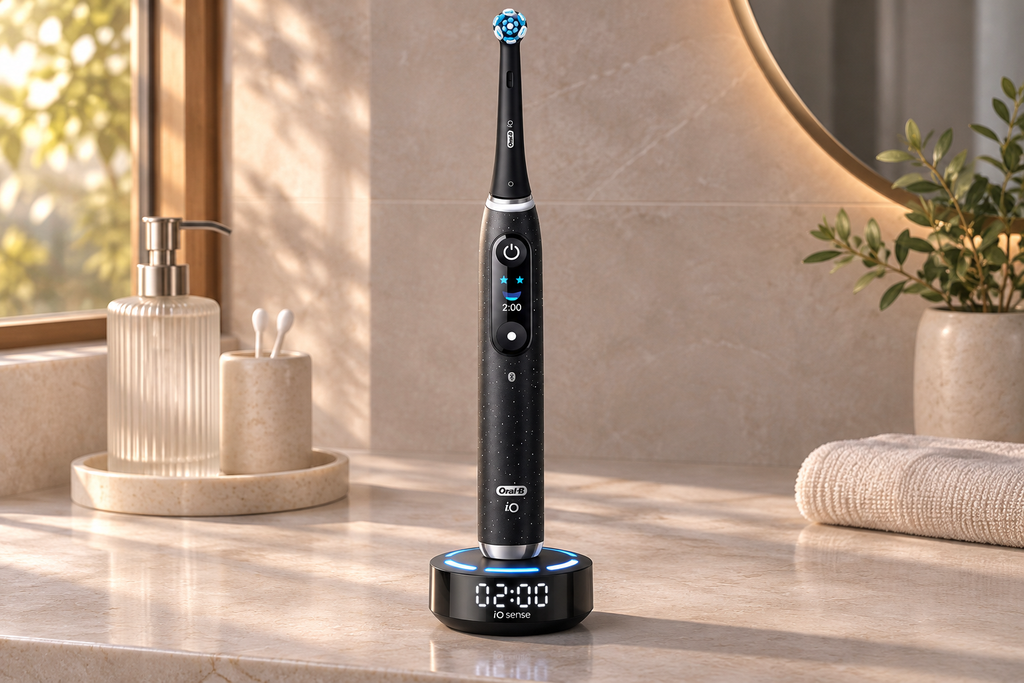
The iO Sense charger provides real-time guidance relating to coverage, timing, and pressure. Its illuminated sections and digital display turn the base into part of the brushing experience, rather than simply a place to recharge the handle.
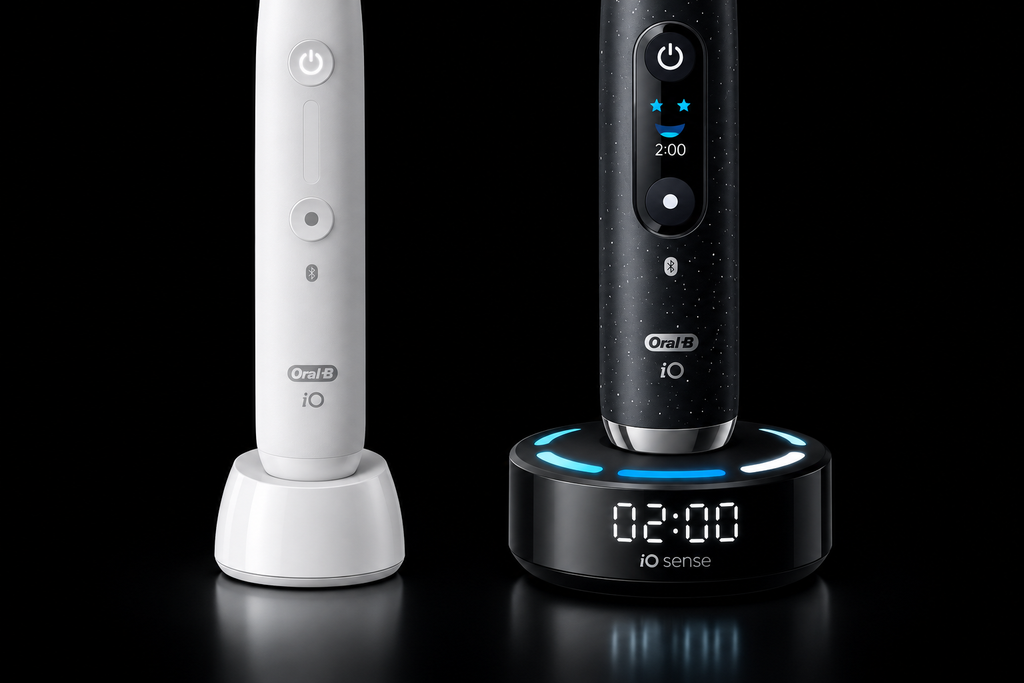
The iO4 charger does not provide that coaching interface. We would not assume that placing an iO4 on a different dock could add the flagship’s features; chargers and supported functionality must match the handle.
Think About Where the Charger Will Live
We would picture our bathroom before paying for iO Sense. Will the base sit in clear view? Is there an appropriate place for the power connection? Do we normally remain near the sink while brushing?
If the charger will be hidden behind toiletries or kept somewhere else, the premium feature may be less convenient than it appears in a product photo. If it will sit right in front of us, the extra guidance may fit naturally into our routine.
That makes iO Sense a personal convenience decision. It is an appealing addition for some households, but it is not a reason every iO4 owner needs to upgrade.
Charging Speed: A Clear Advantage for the iO10
The iO10 is advertised with approximately three-hour charging using the appropriate fast charger. The iO4 takes substantially longer to reach a full charge.
Manufacturer guidance for the iO4 is not completely consistent: P&G support and established manuals give around 16 hours, while a US iO4 getting-started guide gives about 12 hours. We would plan for a long recharge and follow the manual supplied with the exact handle and charger.
The reliable purchasing takeaway is the difference in convenience. The iO10 is the faster-charging option; we should not expect the iO4 to become a three-hour model because a retailer loosely describes its charging technology.
Does Faster Charging Mean Longer Battery Life?
No. Charging speed and time between charges are separate questions. A brush can recharge faster without lasting longer in normal use.
We would avoid promising a fixed number of days for either model. Session length, chosen settings, battery condition, and usage habits can affect endurance. If we recharge routinely, slower charging may be a minor inconvenience. If we frequently forget until shortly before traveling, the iO10’s faster recharge becomes more attractive.
Travel Cases and What Comes in the Box
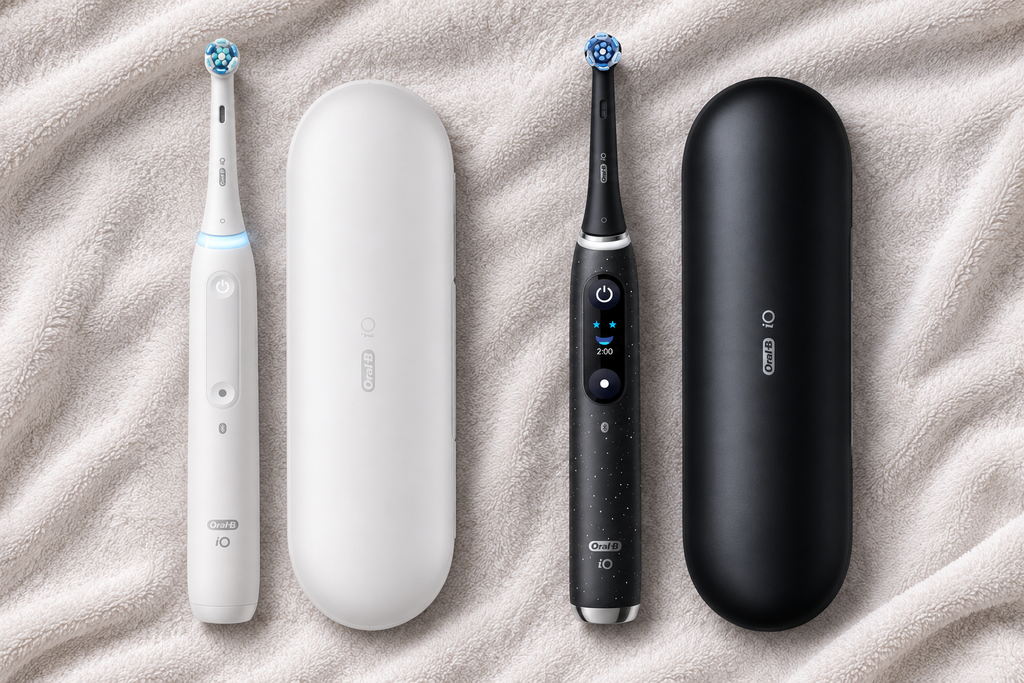
The iO4 is offered in packages with a basic travel case, while advertised premium iO10 kits include a charging travel case. However, bundles vary, so we would check the written contents list for the exact offer.
A protective case and a charging case are not interchangeable descriptions. We would also check whether a charging case needs an external power connection rather than assuming it operates as an independent battery pack.
For someone taking occasional short trips, a basic case may be enough. For frequent travel, the organization and charging arrangements of the complete kit deserve more attention. The most useful package is the one that works with how we pack and recharge.
Our Pre-Purchase Bundle Checklist
- Confirm the offer includes a handle, compatible head, and appropriate charger.
- For the iO10, verify that the iO Sense base is explicitly included.
- Check whether the travel case charges or only protects the brush.
- Compare the number and type of included replacement heads.
- For the iO4, confirm Bluetooth if it is a required feature.
- Check the product’s intended market and the seller’s support terms.
We would not treat the largest-looking bundle as the best deal automatically. Extra accessories have value only if we would otherwise buy and use them.
Replacement Heads and Long-Term Cost
Both models accept Oral-B iO replacement heads. Conventional Oral-B heads designed for other systems are not a substitute, so we would look specifically for iO compatibility.
The shared head family makes the running-cost comparison relatively straightforward. If we use the same head type and replacement schedule, choosing the iO10 does not automatically reduce refill spending.
For an illustrative budget, assume each head costs $8 and we use four per year. That gives a $32 annual allowance, or $96 over three years, for either model. These figures are examples, not current retail quotes; actual prices and replacement needs vary.
This is why we would compare the initial handle premium carefully. The iO4 can save money at purchase while leaving access to the same refill family. We would not spend the entire budget on the handle and then overlook the ongoing cost of keeping suitable heads available.
Price and Value: How We Would Compare Offers
We would use final checkout prices for equivalent packages, rather than comparing one model’s sale price with the other’s original launch price. The useful number is the amount we actually need to pay to obtain the features and accessories we want.
Consider these hypothetical offers:
| Example | iO4 price | iO10 price | Additional spending |
|---|---|---|---|
| Large premium | $90 | $300 | $210 |
| Discounted flagship | $100 | $200 | $100 |
| Very close offers | $120 | $170 | $50 |
These are decision-making examples, not live prices or advertised deals. At a $210 difference, we would want a strong reason to buy the premium model. At a $50 difference, its screen, fast charging, and smart base become easier to justify if the packages and seller conditions are comparable.
Calculate the Extra Cost Without Minimizing It
We can divide a hypothetical $150 premium by three years to get $50 per year. That can help us think about the purchase, but it does not guarantee a three-year lifespan or make the upfront cost disappear.
We would use that calculation only after deciding the upgrade is affordable and useful. A small-looking daily figure is not a good reason to purchase features we do not want.
Which Is Better for a First Electric Toothbrush?
We would usually recommend starting with the iO4 when the aim is to obtain the iO cleaning platform without a large initial expense. Its timer, pressure feedback, and four modes provide a useful foundation without requiring us to learn a screen and coaching system at the same time.
The iO10 makes sense for a first-time buyer who specifically enjoys connected technology and wants feedback to be a central part of the experience. We would frame it as a preference for guidance and convenience, not a prerequisite for switching successfully.
Should an Existing iO4 Owner Upgrade?
We would upgrade only after identifying what the current brush fails to provide. Wanting faster charging, clearer mode information, or detailed coverage coaching gives us a concrete reason to consider the iO10.
If the iO4 works properly and its routine feels comfortable, keeping it is a reasonable choice. There is no need to replace a functioning handle simply because a flagship has more features.
We also would not assume that changing the charger or installing an app update turns the iO4 into the iO10. Hardware differences, compatibility, and supported functions matter. Buy the model for the capabilities explicitly advertised for that unit.
Our Buying Recommendation
Choose the iO4 for a Practical, Lower-Cost Routine
We would choose the iO4 when the priority is value, the available modes cover our preferences, and we do not need a color screen or advanced tracking. Its slower charging is easier to accept when we have a regular charging routine.
Before ordering, we would confirm the exact version and accessories. That is particularly important if app connectivity is part of the reason for choosing it.
Choose the iO10 for Feedback and Convenience
We would choose the iO10 when its screen, fast charging, and iO Sense base all have a clear place in our routine. Its case becomes stronger if a discount narrows the difference in total cost.
The premium is harder to defend when we plan to ignore the screen, avoid the app, and leave the smart base out of sight. We would buy the extra features because we want to use them.
Conclusion
Our Oral-B iO 4 vs 10 verdict is that the iO4 is the better starting point for value, while the iO10 offers the more complete guidance and convenience package.
The iO4 already includes much of what makes the iO range appealing. The iO10 earns consideration through its color screen, advanced tracking, iO Sense base, and faster charging. We would compare the exact versions and bundles, then pay more only for improvements we expect to use.
Frequently Asked Questions
1. What is the main difference between the Oral-B iO4 and iO10?
The iO10 adds a color display, seven rather than four modes, advanced tracking, the iO Sense smart charger, and faster charging. The iO4 focuses on a simpler interface while retaining the core iO cleaning approach, pressure feedback, and a timer.
2. Does every Oral-B iO4 have Bluetooth?
We would not assume so. Connected iO4 versions advertise Bluetooth, but some newer US manufacturer comparisons list the iO4 without app connectivity. Check the exact product code, packaging, and seller description if this feature matters.
3. Does the Oral-B iO10 clean better than the iO4?
The iO10’s higher price does not establish a proportional cleaning improvement. Both use the iO cleaning platform. We would choose the iO10 for its additional guidance and convenience, without promising that every user will achieve better results.
4. Do the Oral-B iO4 and iO10 use the same brush heads?
Yes, both use Oral-B iO replacement heads. Check for iO compatibility rather than buying conventional Oral-B heads designed for other systems. The appropriate head choice does not require purchasing the flagship handle.
5. How much faster does the iO10 charge than the iO4?
The iO10 is advertised at about three hours with its appropriate fast charger. Different manufacturer guidance gives approximately 12 or 16 hours for the iO4, so check the manual for the exact unit. Either way, the iO10 offers a substantially shorter full recharge.