
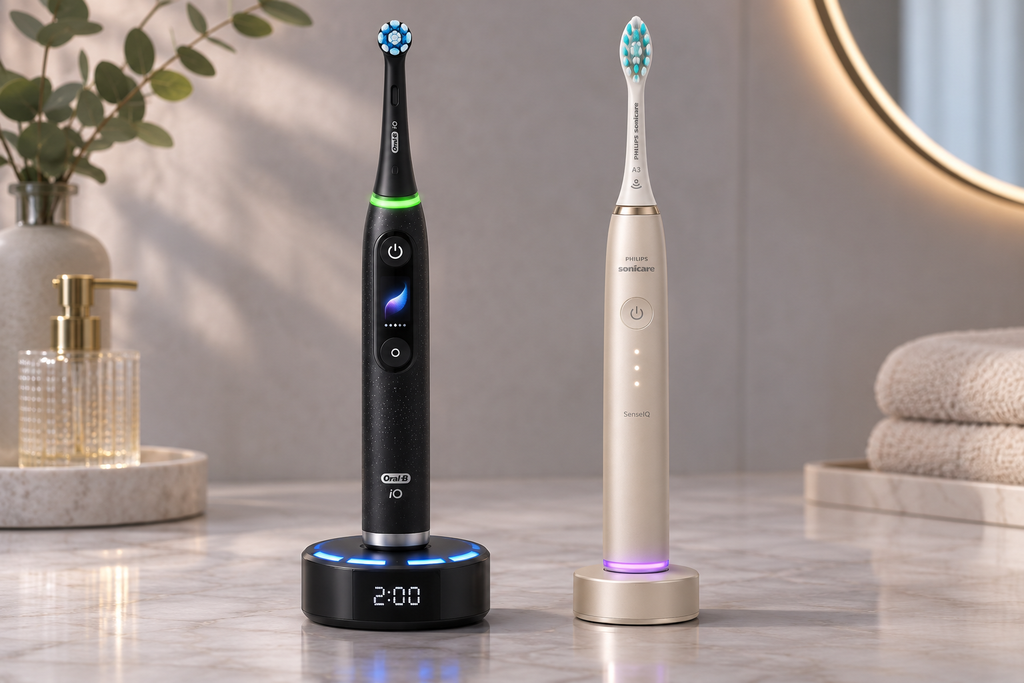
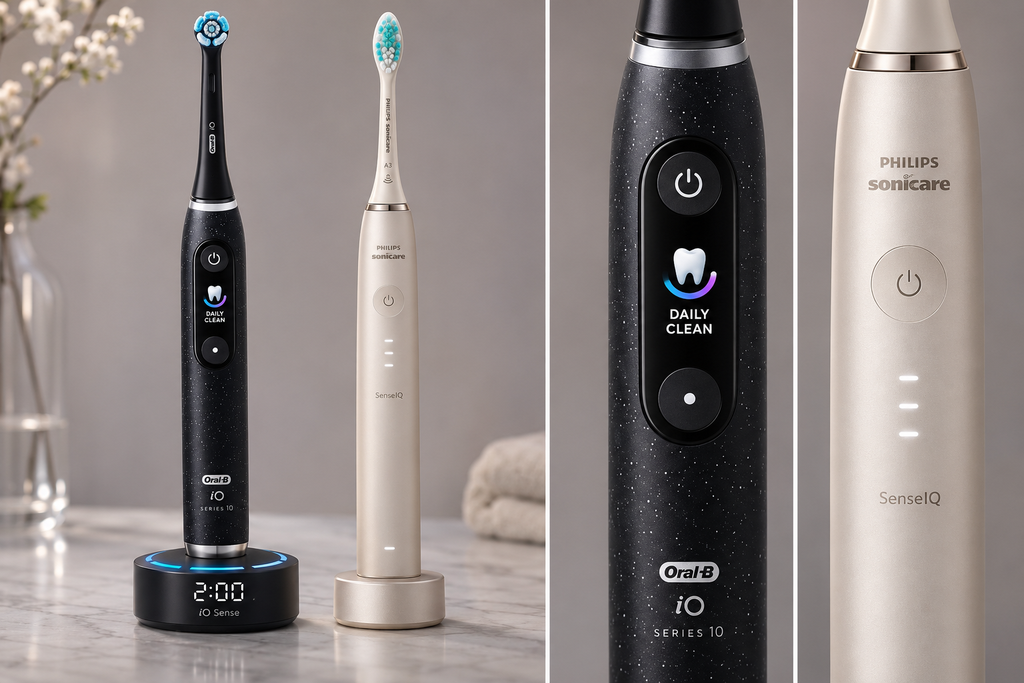
Comparing the Oral-B iO 10 vs Sonicare 9900 Prestige brings us to two different approaches to premium electric brushing. Oral-B combines a small round brush head with a color display and an intelligent charging base. Philips uses an elongated sonic brush head, a minimalist handle, and SenseIQ technology that monitors brushing and adapts intensity.
Both offer more technology than we need for a basic two-minute brushing routine. The real question is which features make that routine easier—and which ones we would actually use after the excitement of a new toothbrush wears off.
We would choose the Oral-B iO 10 for its visible feedback, round brush head, and faster charging. We would choose the Sonicare 9900 Prestige for its streamlined design, adaptive brushing experience, and compact charging travel case. Neither choice automatically guarantees cleaner teeth.
This comparison covers the original Philips Sonicare 9900 Prestige with SenseIQ, including the HX9990 family. The newer DiamondClean 9900 Prestige has different features, including an on-handle mouth map and additional modes. Check the complete model number when comparing listings.
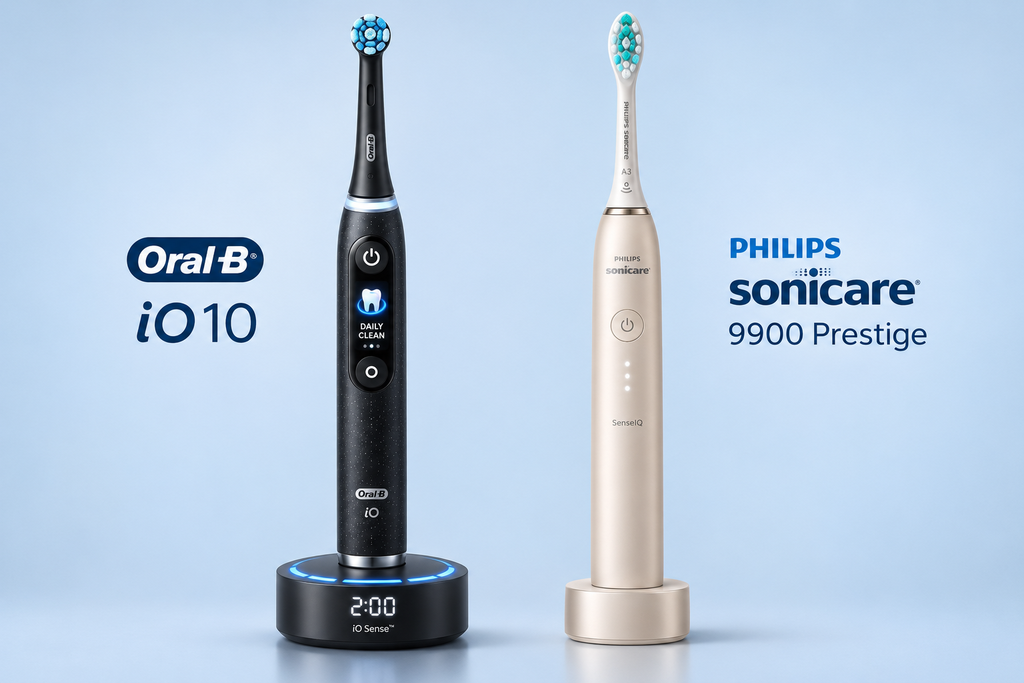
Oral-B iO 10 vs Sonicare 9900: Quick Comparison
| Feature | Oral-B iO Series 10 | Original Sonicare 9900 Prestige |
|---|---|---|
| Brushing technology | Oscillating-rotating round head with micro-vibrations | Sonic action with elongated brush head |
| Typical supplied head | Oral-B iO head; bundle varies | A3 Premium All-in-One; bundle varies |
| Handle display | Interactive color display | No graphical display |
| Brushing modes | Seven | Five |
| Intensity selection | Primarily organized through brushing modes | Three intensity levels |
| Pressure feedback | Visible pressure ring | Light ring and vibration feedback |
| Adaptive features | Check the exact version and listing | SenseIQ can reduce intensity when excessive pressure is detected |
| Charging base | iO Sense base with brushing feedback | Conventional charging stand |
| App connectivity | Oral-B app | Philips Sonicare app |
| Coverage guidance | App tracking plus iO Sense guidance | App-based brushing guidance |
| Charging time | Approximately three hours | Approximately 16 hours; follow the supplied instructions |
| Charging travel case | Commonly included; check the bundle | Commonly included; check the bundle |
| Replacement heads | Oral-B iO-specific heads | Compatible Sonicare click-on heads |
| Main appeal | Screen, countertop guidance, fast charging | Minimalist design and adaptive sonic brushing |
Accessories and specifications can vary by country, edition, and package. A discounted bundle with fewer heads may offer less value than its headline price suggests.
The Biggest Difference Is How They Brush
Before comparing apps or charging cases, we would start with the brush head. It affects every brushing session.
Oral-B iO 10: A Small Round Head
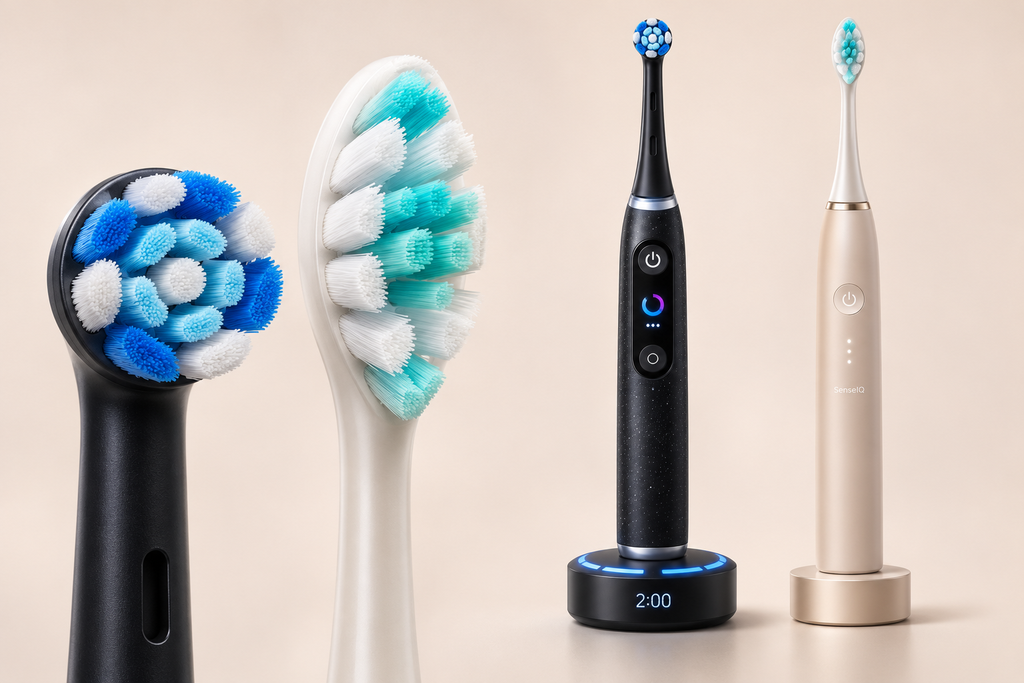
The iO 10 uses a round head designed to work around individual teeth. Its oscillating-rotating action combines with micro-vibrations.
For someone who likes a compact head, that shape can make positioning feel straightforward. We guide it slowly from tooth to tooth, allowing the powered movement to do the work.
The important distinction is technique: buying an expensive electric brush does not mean we should scrub harder. We still need to reach the outer, inner, and chewing surfaces deliberately.
Sonicare 9900: An Elongated Sonic Head
The original Sonicare 9900 Prestige commonly comes with an A3 Premium All-in-One head. Its elongated shape looks more familiar to anyone switching from a manual toothbrush.
The sonic action creates a different sensation from Oral-B’s round-head movement. Some people prefer that feel immediately; others need time to get used to it.
We would not assume one sensation indicates more effective cleaning. Stronger vibration, a louder sound, or a more noticeable movement does not reliably tell us which toothbrush is cleaning better.
Which Brush Head Shape Should You Choose?
If you already enjoy an Oral-B round head, the iO 10 preserves that general approach while adding premium controls and feedback.
If you prefer the shape and feel of a Sonicare brush, the 9900 Prestige is the more familiar option.
For a first-time buyer, personal preference matters. A toothbrush that feels comfortable enough to use thoroughly twice a day has a practical advantage over one whose features look impressive but whose brushing sensation you dislike.
Does the Oral-B iO 10 Clean Better Than the Sonicare 9900?
We would not declare a clinical winner simply by comparing their feature lists.
Both are designed to support effective daily plaque removal. However, manufacturer claims comparing a powered brush with a manual toothbrush do not establish that it outperforms the competing premium model.
Likewise, seven modes do not automatically clean better than five. Advertised movement counts also cannot be compared directly across different brushing technologies.
For everyday use, the useful questions are more practical:
- Do we brush every surface?
- Do we use appropriate pressure?
- Do we complete the recommended brushing time?
- Do we replace a worn head?
- Do we clean between teeth as part of our routine?
The extra technology matters when it helps us improve those habits. It has less value when it becomes something we ignore.

- A3 Premium All-in-One brush head removes up to 20x more plaque than a manual toothbrush; achieve 15x healthier gums in s…
- SenseIQ Technology senses your pressure, motion, and coverage up to 100 times per second; if you apply too much pressure…
- Gentle yet effective clean with up to 62,000 bristle movements per minute; Sonicare Fluid Action supports the bristles t…

- Contents: electric toothbrush including 1 brush head (ultimate cleaning), charging travel case, replacement brush case, …
- Toothbrush coach with iO SENSE for real-time feedback on coverage, time and pressure – directly via the charging station…
- Practical on the go with charging travel case, 3H fast charging with magnetic charging station and battery status tracki…
iO Sense vs SenseIQ: What Is the Difference?
These names sound similar, but they describe different features.
Oral-B iO Sense: Feedback From the Charging Base
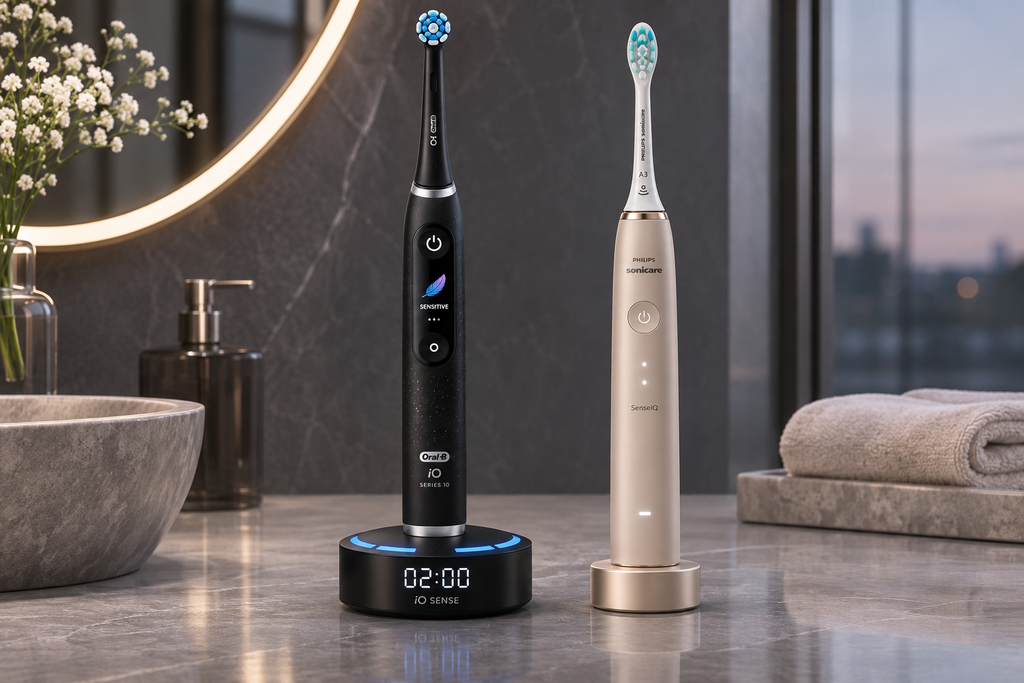
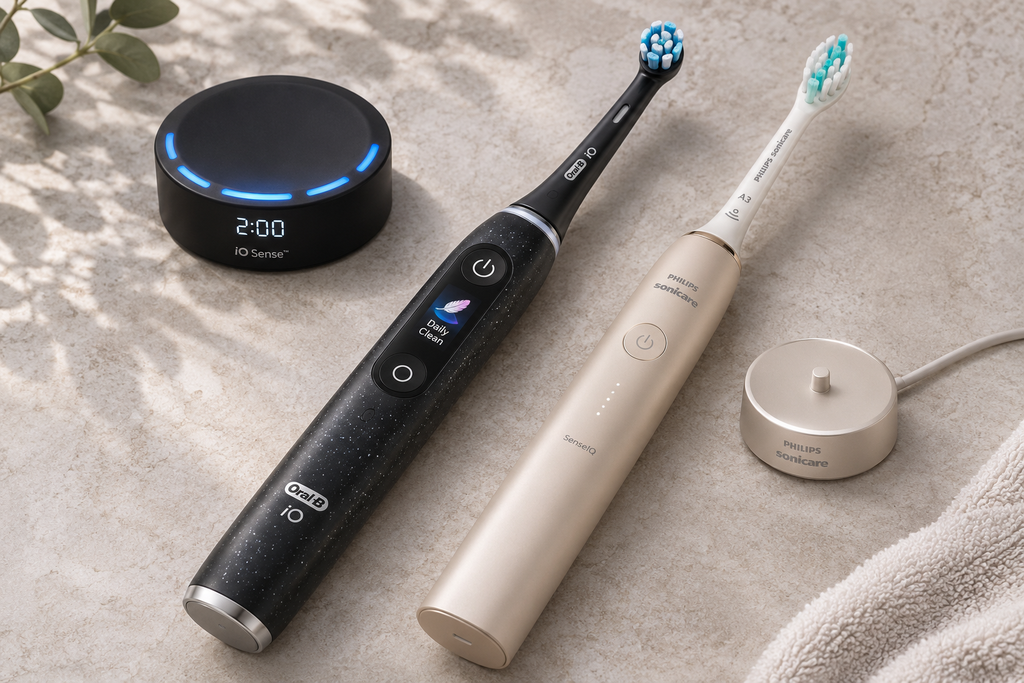
The iO 10’s defining accessory is its iO Sense charging base.
Alongside charging, it provides feedback about brushing time, pressure, and coverage. This means we can receive useful guidance without keeping a phone beside the sink.
That is the strongest reason to consider the iO 10 over a less expensive electric toothbrush. If we rarely open brushing apps but still want visible coaching, the base offers a convenient middle ground.
It needs a sensible position on the countertop, though. If we keep the charger inside a cabinet or behind other bathroom items, we lose much of that convenience.
The base’s coverage guidance also should not be confused with the more detailed tracking available through the app.
Philips SenseIQ: Monitoring and Adaptation in the Handle
SenseIQ focuses on how we brush.
The original Sonicare 9900 Prestige monitors pressure, movement, and coverage. When it detects excessive pressure, it can reduce brushing intensity.
This is useful for people who tend to press harder without noticing. The brush can respond during the session, while its light and vibration feedback encourage a change in technique.
However, automatic adaptation is not permission to keep pressing. It is a support feature, and our goal should still be gentle, controlled brushing.
Which Approach Fits Your Routine?
We would favor iO Sense if we want feedback that is easy to see on the countertop.
We would favor SenseIQ if we prefer a simpler-looking handle with adaptive behavior working in the background.
When checking newer Oral-B listings, read the exact specifications rather than assuming every iO 10 version has an identical feature set.
Display and Controls: Informative or Minimalist?
The Oral-B iO 10 Has the More Informative Handle
The iO 10’s color display makes the toothbrush feel interactive. It provides information about brushing modes and status directly on the handle.
That can make it easier to understand which setting is selected. It also reduces reliance on remembering indicator patterns.
For people who enjoy visible controls and feedback, the display is a meaningful convenience. For others, it may become something they rarely look at after choosing a favorite mode.
The Original Sonicare 9900 Keeps Things Simple
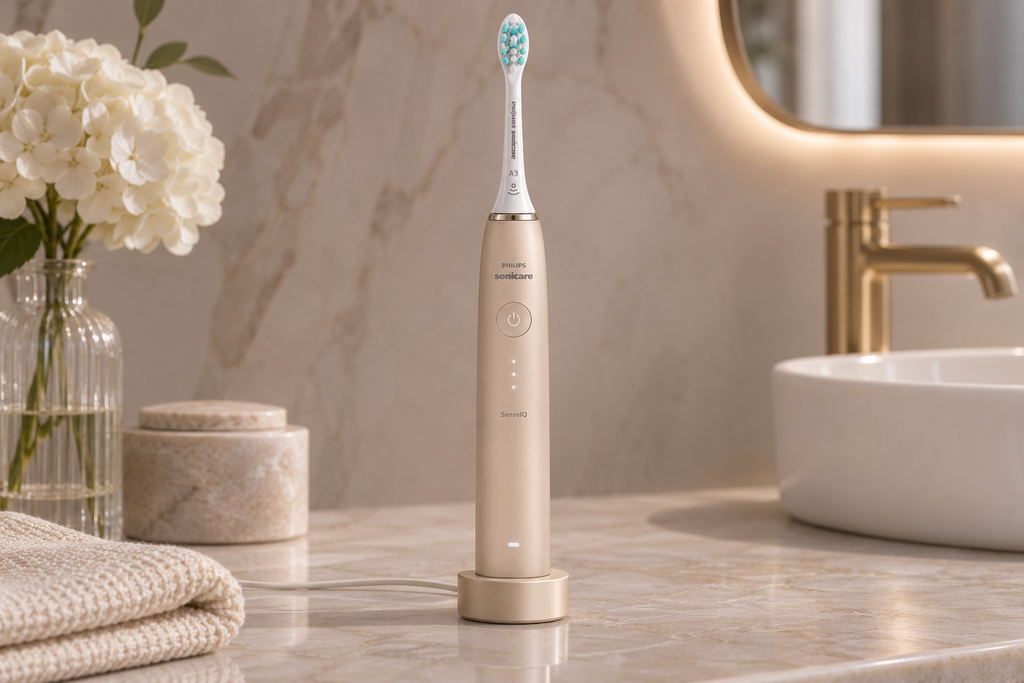
The original 9900 Prestige has a much more restrained appearance. There is no graphical screen or on-handle mouth map.
Its controls and indicators communicate essential information, while the app provides access to more detailed settings and guidance.
We like this approach for someone who wants a premium toothbrush without a busy interface. However, buyers who dislike using apps for configuration may prefer the more explicit display on the Oral-B.
Do not confuse the original screenless Sonicare 9900 with the newer DiamondClean 9900 when comparing product photos.
Brushing Modes: Seven vs Five
The Oral-B iO 10 offers seven modes:
- Daily Clean
- Sensitive
- Super Sensitive
- Whiten
- Gum Care
- Intense
- Tongue Clean
The original Sonicare 9900 Prestige offers five:
- Clean
- White+
- Gum Health
- Deep Clean
- Sensitive
Philips also provides three intensity levels.
Does Oral-B Win Because It Has More Modes?
Not necessarily.
The iO 10 gives us more named modes, including Tongue Clean and Super Sensitive. Philips gives us a different combination of modes and adjustable intensity.
Counting every Philips mode-and-intensity combination as a separate mode would make the comparison misleading. These are different ways of organizing the brushing experience.
| Brushing preference | Oral-B option | Philips option |
|---|---|---|
| Everyday routine | Daily Clean | Clean |
| Gentler session | Sensitive or Super Sensitive | Sensitive with a suitable intensity |
| Surface-stain-focused routine | Whiten | White+ |
| Gum-focused routine | Gum Care | Gum Health |
| More intensive routine | Intense | Deep Clean |
These settings are not exact equivalents. Their timing and behavior differ.
For most buyers, finding one comfortable everyday setting matters more than regularly cycling through every available option.
Pressure Feedback: Which Is Easier to Understand?
The iO 10 uses a visible ring near the top of the handle. Its pressure feedback distinguishes between insufficient, appropriate, and excessive pressure through its lighting system.
That is helpful because the feedback is not limited to telling us when something is wrong. It can also indicate when pressure is within the intended range.
The original Sonicare 9900 Prestige uses feedback near the base of the handle, including a purple warning light and vibration when excessive pressure is detected. SenseIQ can also lower intensity.
The best implementation depends partly on how we brush. Someone who watches the mirror may appreciate Oral-B’s upper light ring. Someone who responds more readily to tactile feedback may prefer Philips’ approach.
Neither system replaces attention to technique, and neither should be treated as a diagnostic tool for gum health.
Apps and Coverage Tracking
Both toothbrushes connect to smartphone apps that can provide guidance and help us review brushing habits.
Oral-B App Experience
The iO 10 supports detailed brushing tracking through the Oral-B app. It can help identify areas that receive insufficient attention.
Combined with the screen and iO Sense base, this creates several ways to receive feedback.
That flexibility is attractive, although it also means we should be honest about what we will use. If we ignore the app and keep the base out of sight, we may be paying for capabilities that contribute little to our routine.
Philips Sonicare App Experience
The Sonicare app provides coaching and brushing history, along with configuration options for the original 9900 Prestige.
It is useful for reviewing habits and making adjustments. We do not need to stare at a phone during every brushing session to use the toothbrush normally.
App-based coverage estimates should be interpreted as guidance. They do not confirm that every surface is plaque-free.
Can You Use Either Toothbrush Without the App?
Yes. Both function as electric toothbrushes without an active phone connection.
The difference is how much connected functionality we want to access. Philips relies more on the app for its wider settings experience, while Oral-B puts more visible information on the handle and charging base.
Charging Speed: A Clear Oral-B Advantage
Charging speed is one of the most concrete differences in this comparison.
The iO 10 supports a full charge in approximately three hours. The original Sonicare 9900 Prestige requires a considerably longer charging period, around 16 hours according to its charging guidance.
That difference matters if we frequently forget to charge a toothbrush before traveling.
If the brush normally returns to its stand between uses, charging speed may be much less important. A slow charging cycle can happen while the toothbrush is sitting unused overnight and during the day.
Also, charging speed and battery endurance are separate issues. We should not assume that a brush with a faster charger necessarily lasts longer between charges.
Battery Life: Avoid Overly Simple Comparisons
Philips lists approximately 14 days of operating time for the original model on its US product page. Actual endurance depends on brushing duration, frequency, settings, and battery condition.
We would be cautious about promising a universal number of days for either toothbrush. Reviews and retailer listings may use different test conditions, while product variants can further complicate comparisons.
For travel, the more useful question is whether the supplied charging arrangement fits our routine.
If we take short trips, a full charge may be enough. For longer stays, packing the correct charging case and compatible power supply removes much of the uncertainty.
Travel Cases: Both Are Useful, but Check the Bundle
Oral-B iO 10 Travel Case
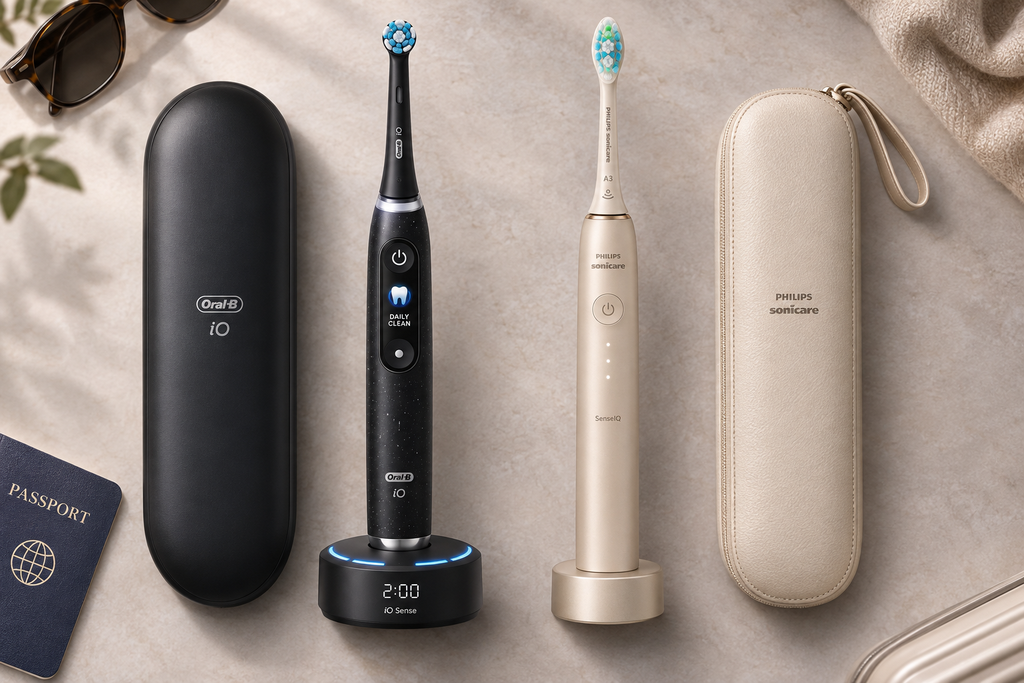
Standard premium iO 10 packages commonly include a charging travel case.
It protects the brush during transport and provides a way to charge away from the main bathroom base. That is convenient for buyers who want to leave the iO Sense charger permanently at home.
Check the included power accessories before traveling. A charging case is not necessarily a self-contained battery pack.
Sonicare 9900 Prestige Travel Case
The original Sonicare 9900 Prestige is known for its slim charging travel case with a textured exterior and carrying loop.
Its USB charging arrangement is convenient for travel, although the exact cable and power requirements should be checked against the supplied package.
We would lean toward Philips if a compact, understated travel setup is a priority. However, we would compare the actual cases included in the listings rather than relying only on promotional photos.
Replacement Heads and Long-Term Cost
Both toothbrushes require replacement heads, so the purchase price tells only part of the story.
Oral-B iO Heads
The iO 10 uses Oral-B iO-compatible heads.
Standard Oral-B heads for other handle families do not fit the iO system. This is especially important if another family member already owns an older Oral-B toothbrush and you expect to share replacement-head packs.
Choose the head according to your preferences and the manufacturer’s compatibility information.
Philips Sonicare Heads
The original 9900 Prestige commonly includes the A3 Premium All-in-One head.
Other compatible Sonicare click-on heads may provide alternative shapes or bristle arrangements. Confirm compatibility, especially when you want smart head-recognition features as well as a physical fit.
An existing supply of suitable Sonicare heads can make staying with Philips more economical.
A Simple Running-Cost Example
The following figures are hypothetical, not current retail prices:
| Cost item | Example A | Example B |
|---|---|---|
| Replacement-head price | $9 | $14 |
| Four heads per year | $36 | $56 |
| Three-year head cost | $108 | $168 |
That creates a $60 difference over three years.
Multipacks and promotions can change the calculation substantially. Compare the price per genuine compatible head, rather than the pack price alone.
Which Toothbrush Offers Better Value?
We would assess value according to the price gap and the features we expect to use.
The iO 10 is easier to justify when we specifically want its smart base, color display, and fast charging. If those features solve everyday frustrations, they can be worth paying for.
The Sonicare 9900 Prestige is easier to justify when we prefer sonic brushing, want SenseIQ adaptation, and value its restrained design and travel case.
However, neither is automatically the best-value electric toothbrush overall. Less expensive models can provide the fundamental brushing features many people need.
A premium purchase makes most sense when we can name the premium feature we will use regularly.
Which One Should You Buy?
| Your priority | Our preference |
|---|---|
| A small round brush head | Oral-B iO 10 |
| An elongated sonic brush head | Sonicare 9900 Prestige |
| A color display on the handle | Oral-B iO 10 |
| Guidance without opening an app | Oral-B iO 10 |
| Minimalist handle design | Sonicare 9900 Prestige |
| SenseIQ pressure-related intensity adaptation | Sonicare 9900 Prestige |
| Faster full charging | Oral-B iO 10 |
| A compact USB charging travel setup | Sonicare 9900 Prestige, subject to bundle |
| Keeping existing compatible Sonicare heads | Sonicare 9900 Prestige |
| Lowest ownership cost | Compare current bundles and head prices |
Choose the Oral-B iO 10 If…
You want a toothbrush that communicates clearly through its screen, pressure ring, and charging base.
We would particularly consider it for someone who wants coaching but does not want a smartphone involved in every brushing session. Its fast charging is another practical advantage.
Choose the Sonicare 9900 Prestige If…
You prefer the feel of sonic brushing and want a cleaner, simpler handle design.
We would particularly consider it for an existing Sonicare user who values SenseIQ and wants a refined travel setup without switching to a different brushing technology.
If You Already Own a Good Electric Toothbrush
An upgrade deserves more thought.
If your current brush works well, has useful pressure feedback, and supports a routine you maintain consistently, a more expensive model may add convenience without transforming the outcome.
Before upgrading, identify the problem you want to solve: uncomfortable brushing, missed areas, inconvenient charging, or poor travel portability.
Conclusion: Oral-B iO 10 vs Sonicare 9900
The Oral-B iO 10 vs Sonicare 9900 Prestige decision comes down to brushing preference and the kind of feedback we find useful.
Our choice for visible guidance and convenience is the Oral-B iO 10. Its color screen, iO Sense base, round head, and faster charging create a compelling package for buyers who want an interactive brushing routine.
Our choice for minimalist design and adaptive sonic brushing is the original Sonicare 9900 Prestige. SenseIQ, adjustable intensity, and its charging travel case make it appealing to people who prefer Philips’ approach.
We would prioritize comfort and consistent use over the number of modes. Then we would compare the exact model number, included accessories, and replacement-head costs before buying.
Frequently Asked Questions
1. Is the Oral-B iO 10 better than the Sonicare 9900 Prestige?
The iO 10 is better suited to buyers who want a round head, a color display, faster charging, and guidance from the charging base. The original Sonicare 9900 Prestige suits buyers who prefer sonic brushing, SenseIQ adaptation, and a minimalist handle. Neither is a universal cleaning winner.
2. Which is better for sensitive teeth?
Both offer settings intended for gentler brushing. The iO 10 includes Sensitive and Super Sensitive modes, while the original Sonicare 9900 Prestige offers a Sensitive mode and adjustable intensity. Head choice and gentle technique also matter. Persistent sensitivity should be assessed rather than managed only by changing brush settings.
3. Can I use either toothbrush without connecting my phone?
Yes. Both work without an active smartphone connection. The apps provide additional settings, tracking, and guidance. The iO 10 also provides visible information through its handle display and iO Sense charging base.
4. Do the Oral-B iO 10 and Sonicare 9900 use interchangeable heads?
No. The Oral-B iO 10 requires iO-compatible heads, while the Sonicare 9900 Prestige uses compatible Philips Sonicare click-on heads. Their brush heads, charging bases, and travel accessories should not be treated as interchangeable.
5. Is every Philips Sonicare 9900 the same model?
No. The original 9900 Prestige with SenseIQ, including the HX9990 family covered here, differs from the newer DiamondClean 9900 Prestige. The newer generation adds features such as an on-handle mouth map and additional modes. Always check the full model number before comparing specifications.