
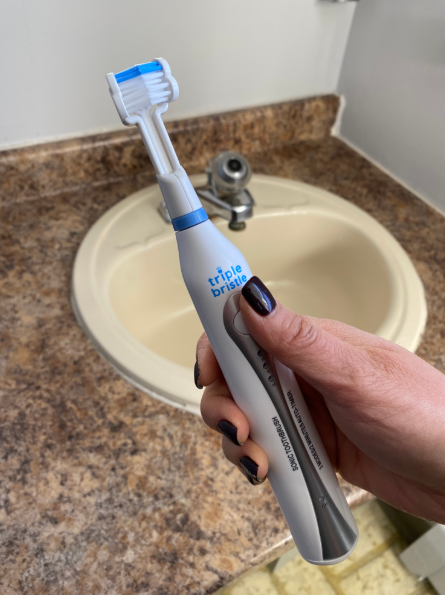
If you have seen a toothbrush with three separate rows of bristles wrapping around the teeth, you may have stopped and wondered: is Triple Bristle good, or is it simply an unusual dental gadget?
It certainly looks different. Instead of brushing one surface at a time, the Triple Bristle toothbrush surrounds the tooth and attempts to clean the front, back, and chewing surfaces simultaneously. Think of it as a tiny tunnel through which each tooth passes.
That sounds wonderfully efficient. However, clever design does not automatically guarantee better results for everyone.
The honest answer is that Triple Bristle can be good, particularly for people who struggle with brushing technique, have limited hand movement, frequently miss the backs of their teeth, or simply want a more guided routine. At the same time, it is not necessarily superior to every conventional electric toothbrush, and its larger head may feel uncomfortable to some users.
Let us examine how it works, what research suggests, who may benefit from it, and whether it deserves a place beside your bathroom sink.
What Is a Triple Bristle Toothbrush?
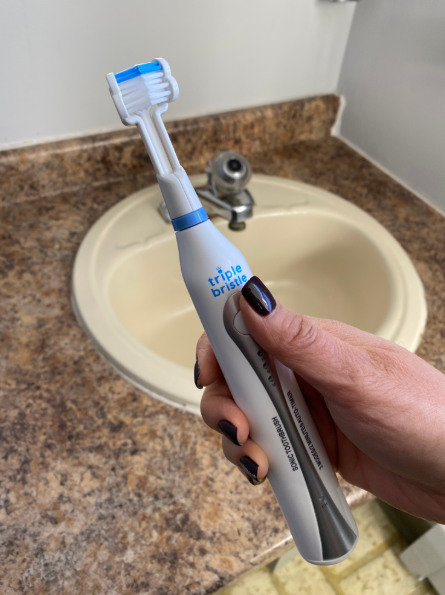
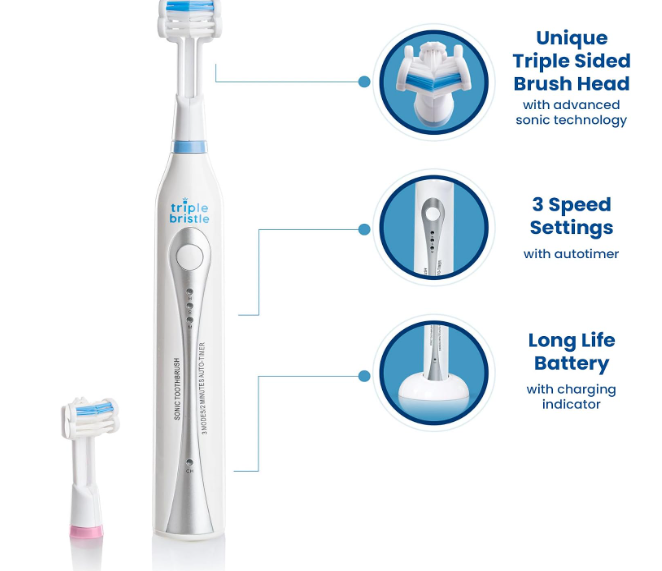
Triple Bristle is a powered toothbrush built around a three-sided brush head. Rather than placing bristles on only one flat surface, its head contains three connected sections.
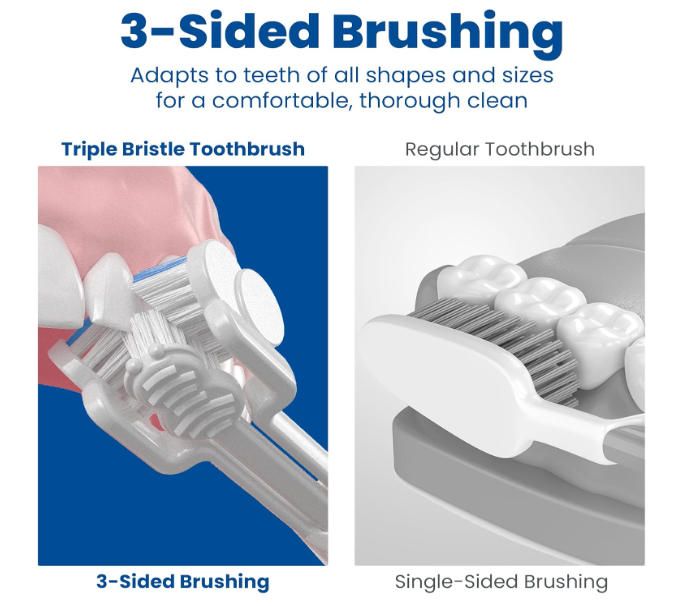
One section cleans the outer surface of the teeth, another reaches the inner surface, and the middle section contacts the biting surface. When correctly positioned, the head partially surrounds each tooth.
The electric handle produces sonic vibrations while the user slowly guides the brush along the dental arch.
According to the manufacturer, its sonic models include a two-minute automatic timer and pause every 30 seconds to encourage users to move to another section of the mouth.
This guided design addresses a common problem: many of us brush the visible front surfaces carefully while rushing through—or completely forgetting—the less visible areas behind our teeth.
How Is It Different From a Regular Toothbrush?
A conventional toothbrush places all its bristles on one side of the head. We must deliberately position it against every surface:
- Outside surfaces
- Inside surfaces
- Chewing surfaces
- Gumline
- Back molars
A three-sided toothbrush attempts to contact several of these areas at once.
That does not make brushing completely automatic. We still need to place the head correctly, move it slowly, cover the entire mouth, use toothpaste, and clean between the teeth. Nevertheless, the design reduces the number of angles we must consciously manage.
Is Triple Bristle Sonic or Rotating?
Triple Bristle uses sonic vibration rather than the oscillating-rotating action associated with many round-headed electric toothbrushes.
A sonic toothbrush moves its bristles rapidly from side to side. An oscillating-rotating toothbrush uses a small circular head that alternates direction around individual teeth.
Neither technology magically cleans the mouth without proper placement. The key difference is how the head moves and how we guide it.
Is Triple Bristle Good for Cleaning Teeth?
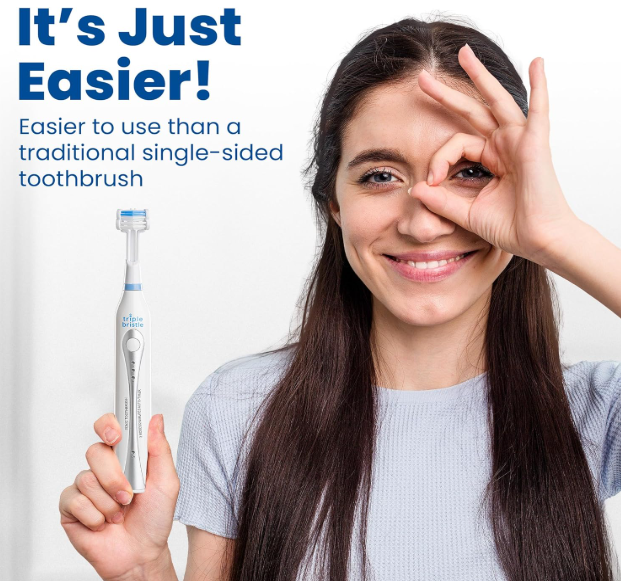
For many people, yes. Triple Bristle can clean teeth effectively when it is used correctly and consistently.
A clinical study comparing a three-sided sonic Triple Bristle brush with a manual toothbrush found that both reduced plaque and bleeding on probing. The three-sided powered brush produced stronger reductions in certain groups and areas, particularly in the lower jaw, although that does not prove it will outperform every other toothbrush for every user.
The broader evidence on triple-headed brushes is mixed rather than universally positive. Some studies find better results in selected populations, while others report performance comparable to conventional brushes.
That nuance matters.
Triple Bristle is not a magic wand. Its main strength may be that it makes good coverage easier, especially for people whose current technique is inconsistent.
The Real Advantage Is Coverage
Imagine painting a fence with a narrow brush. You can produce excellent results, but you must carefully cover every board and every edge.
Now imagine using a tool that paints three sides at once. It may not produce better paint, but it makes missed areas less likely.
That is the basic appeal of Triple Bristle.
Because the head wraps around each tooth, it can help users contact:
- The visible outer surface
- The tongue-facing inner surface
- Part of the chewing surface
- The gumline from multiple directions
The inside surfaces of the lower front teeth and the backs of the molars are common trouble spots. A guided three-sided head may help us pay attention to them without performing complicated wrist movements.
What Does the Research Say About Three-Sided Toothbrushes?
Research into three-headed toothbrushes is encouraging in some contexts, but it does not establish them as the uncontested champion of oral care.
A 2024 study found that single-headed and triple-headed manual toothbrushes were similarly effective at plaque removal. However, brushing took less time with the triple-headed design.
A 2026 study involving healthy adults likewise reported that a triple-headed manual toothbrush achieved plaque removal comparable to—not better than—a conventional manual brush. The researchers suggested that its practical advantage may be more relevant for people with dexterity challenges.
Research involving young children with limited hand skills found that a triple-headed toothbrush could remove plaque more effectively than a traditional single-headed brush.
Together, these findings suggest a sensible conclusion:
Triple-headed brushes may be most valuable when technique, coordination, time, or complete coverage is the problem.
For an adult who already uses an excellent electric toothbrush perfectly, the difference may be modest. For someone who routinely misses half the tooth surface, the guided design could be genuinely helpful.
Why Study Results Can Differ
Toothbrush studies do not always reach identical conclusions because results depend on several variables:
- The age and health of participants
- Whether the brush is manual or powered
- Existing brushing habits
- The length of the study
- The type of plaque index used
- Whether users receive professional instructions
- Manual dexterity
- Compliance with the brushing routine
A toothbrush may perform beautifully in a supervised study yet produce weaker results at home if people dislike using it. Conversely, a brush that is merely “comparable” in laboratory measurements may deliver better real-world results because users find it easier.
The best toothbrush is not only the one with the strongest motor or cleverest head. It is the one we can use properly every morning and evening.
Main Benefits of Triple Bristle
Triple Bristle’s unusual design offers several practical advantages.
1. It Cleans Multiple Surfaces Simultaneously
This is the headline feature.
The three sections of bristles surround the tooth, allowing the brush to contact the front, back, and biting surfaces during the same pass.
We still need to move along every tooth, but the process can feel more straightforward than constantly rotating a traditional head.
2. It May Reduce Missed Areas
Many people spend most of their brushing time on the teeth visible in the mirror. The inner surfaces receive a hurried farewell, while the last molars sit in the shadows like forgotten luggage.
Triple Bristle’s wraparound design makes it harder to clean only the front surface. When the tooth is centered inside the head, the inner bristles are naturally positioned behind it.
3. It Simplifies Brushing Technique
Traditional brushing instructions often involve holding the brush around a 45-degree angle toward the gumline, making small motions, and systematically moving around the mouth.
That is manageable for many people, but not everyone performs it consistently.
Triple Bristle uses angled side sections that are intended to contact the tooth and gumline without requiring as much manual positioning.
This can make brushing feel less like performing dental geometry before breakfast.
4. It Includes Timing Assistance
The built-in two-minute timer helps users follow the commonly recommended brushing duration. The 30-second pauses encourage equal attention to different sections of the mouth.
The American Dental Association recommends brushing twice daily for two minutes with a soft-bristled toothbrush. It also notes that both manual and powered toothbrushes can be effective.
A timer cannot guarantee perfect cleaning, but it prevents the classic 35-second rush that feels longer than it actually is.
5. It May Help People With Limited Dexterity
People with arthritis, tremors, motor limitations, coordination difficulties, or reduced wrist movement may struggle to rotate a conventional brush around every surface.
Because a three-sided head reduces the need for precise changes in angle, it may offer a more manageable experience.
This does not mean it will suit every disability or medical condition. A dentist, occupational therapist, or caregiver may need to evaluate the person’s specific needs. Still, limited dexterity is one of the most persuasive reasons to consider this design.
6. It Can Be Useful for Caregiver-Assisted Brushing
Brushing another person’s teeth is not easy. The view is limited, the angle is awkward, and the person may move unexpectedly.
A three-sided toothbrush may help caregivers contact several surfaces in a single controlled motion. It can potentially make the routine faster and more predictable for children, older adults, and people who require assistance.
7. It Encourages Slow, Guided Movement
A traditional manual toothbrush invites scrubbing. We may attack the teeth as though trying to remove paint from a wall.
With Triple Bristle, the shape naturally encourages us to place the teeth inside the head and guide it gradually along the arch. That slower approach can help reduce frantic back-and-forth movement.
Potential Disadvantages of Triple Bristle
No toothbrush is perfect, and Triple Bristle has several limitations worth considering before buying it.
The Head Can Feel Large
The three-sided head is bulkier than a conventional toothbrush head. People with small mouths, a sensitive gag reflex, limited opening, or discomfort around the back molars may find it cumbersome.
The sensation can be unusual during the first few uses. Instead of touching one side of the teeth, the bristles surround them. Some users adapt quickly; others never enjoy the feeling.
It Requires Correct Positioning
The design simplifies brushing, but positioning still matters.
If the tooth is not centered inside the head, one group of bristles may make weak contact while another presses too firmly. Users must keep the brush aligned as they move around curved sections of the dental arch.
The tool is forgiving, not foolproof.
Replacement Heads May Be Less Convenient
Conventional replacement heads from major toothbrush brands are commonly available in pharmacies, supermarkets, and online stores.
Specialized three-sided heads may be harder to find locally. They can also cost more than generic manual brushes or compatible replacement heads for widely used electric models.
Before choosing the system, we should consider long-term availability—not merely the price of the starter kit.
It Does Not Clean Between Teeth Completely
Three bristle panels sound comprehensive, but they cannot fully enter the tight contact points between neighboring teeth.
Triple Bristle does not replace:
- Dental floss
- Interdental brushes
- Water flossers when professionally recommended
- Periodontal cleaning
- Routine dental examinations
A toothbrush cleans exposed surfaces. Interdental cleaning addresses spaces the brush cannot adequately reach.
It May Not Be Better Than Premium Alternatives
Research generally supports powered toothbrushes for reducing plaque and gingival inflammation, but not all powered designs perform identically.
Systematic reviews have found that oscillating-rotating brushes can provide advantages over manual and some sonic brushes for plaque and gingivitis reduction.
This does not mean Triple Bristle is ineffective. It means we should avoid assuming that three sides automatically make it the most clinically effective powered toothbrush available.
A high-quality round-headed brush used correctly may be equally suitable—or better—for certain users.
Is Triple Bristle Good for Gums?
Triple Bristle can be suitable for gums when used with gentle pressure and properly maintained soft bristles.
The angled side panels are designed to follow the gumline. This may help remove plaque from the border where the teeth and gums meet, an area closely associated with gingival inflammation.
However, more contact is not always better. If we press a three-sided brush too firmly, pressure may be applied to the gums from both sides at once.
Can It Cause Gum Recession?
A toothbrush alone is not necessarily the cause of gum recession, but aggressive brushing can contribute to gum irritation and tissue wear.
Potential warning signs include:
- Persistent gum soreness
- Increased sensitivity
- Bleeding that continues after regular gentle brushing
- Visible gum recession
- Bristles becoming flattened quickly
- Pain while using the brush
If these symptoms appear, reduce pressure and ask a dental professional to check your technique. Gum bleeding can be associated with inflammation, but it should not simply be ignored or blamed on a new toothbrush without evaluation.
Use a Gentle Grip
Hold the handle as though you were holding a pen rather than a hammer. The bristles need contact, not force.
Sonic movement performs much of the cleaning action. Pressing harder does not make the motor more intelligent.
Is Triple Bristle Good for Sensitive Teeth?
It may be, particularly when the brush head uses soft bristles and the user avoids excessive pressure.
People with sensitive teeth often benefit from:
- Gentle brushing
- Soft bristles
- Desensitizing fluoride toothpaste
- Moderate water temperature
- Professional evaluation of the underlying cause
Sensitivity can come from enamel wear, exposed roots, cavities, cracked teeth, gum recession, or recent dental treatment. Changing toothbrushes may improve comfort, but it cannot diagnose or correct every cause.
If sensitivity is new, severe, or limited to one tooth, schedule a dental examination rather than simply switching products.
Is Triple Bristle Good for Braces?
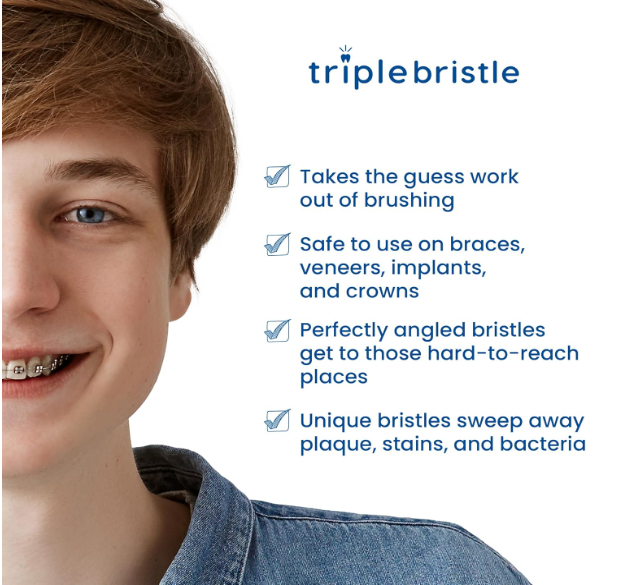
Triple Bristle may clean exposed tooth surfaces around braces, but orthodontic hardware makes the situation more complicated.
Brackets, wires, hooks, and attachments create obstacles. A three-sided head may not sit around each tooth in the intended way because the outer panel encounters the brackets.
As a result, users may still need:
- An orthodontic toothbrush
- A small end-tuft brush
- Interdental brushes
- Floss threaders
- A water flosser
- Instructions from their orthodontist
Triple Bristle should not be assumed to replace specialized orthodontic cleaning tools.
Before using it with braces, confirm that the head moves comfortably around the hardware and ask the orthodontic team whether it fits the cleaning plan they recommend.
Is Triple Bristle Good for Children?
A three-sided brush can be useful for some children, particularly those who have difficulty coordinating a traditional brushing technique.
Research in children aged four to six with limited hand skills found better plaque-removal results with a triple-headed toothbrush than with a conventional single-headed model.
Possible advantages include:
- Simpler positioning
- Faster surface coverage
- Less complicated wrist movement
- Easier caregiver assistance
- More consistent contact with inner surfaces
However, the head must fit the child’s mouth comfortably. A brush designed for adults may feel too large and trigger gagging or resistance.
Children also still require supervision until they can brush thoroughly and manage toothpaste safely. A futuristic toothbrush head does not instantly turn a five-year-old into a dental hygienist.
Who Benefits Most From Triple Bristle?
Triple Bristle may be especially worthwhile for the following users.
People Who Consistently Miss Inner Tooth Surfaces
If plaque frequently builds up behind the lower front teeth or along the tongue-facing surfaces, the wraparound head may improve coverage.
People With Limited Hand Mobility
Users with arthritis, tremors, weakness, coordination difficulties, or reduced wrist movement may appreciate the simplified path.
Caregivers
Parents, family members, and professional caregivers may find the three-sided design easier when brushing another person’s teeth.
People Who Brush Too Quickly
The timer and broad contact area may create a more structured routine.
Users Who Dislike Complicated Technique
Some people understand traditional brushing instructions but do not perform them reliably. Triple Bristle can reduce the mental checklist.
Who May Not Like It?
Triple Bristle may be less suitable for:
- People with very small mouths
- Users with a strong gag reflex
- People who prefer compact round brush heads
- Users with crowded or unusually positioned teeth
- People wearing complex orthodontic appliances
- Shoppers seeking inexpensive generic replacement heads
- Users who already achieve excellent results with another powered brush
Personal comfort deserves more weight than marketing gives it. A technically capable brush that stays unused in a drawer is a poor investment.
Triple Bristle vs. a Regular Manual Toothbrush
A manual toothbrush is affordable, accessible, quiet, portable, and effective when used properly.
Triple Bristle offers more guidance and powered movement. It may also reduce the number of separate angles required to cover the mouth.
| Feature | Triple Bristle | Manual Toothbrush |
|---|---|---|
| Cleaning action | Sonic vibration | Hand movement |
| Head design | Three-sided | Single-sided |
| Timer | Usually included | Usually absent |
| Technique required | Moderate | Higher |
| Portability | Requires charging | Extremely portable |
| Initial cost | Higher | Low |
| Replacement availability | More limited | Widely available |
| Dexterity assistance | Stronger | Limited |
The manual brush wins on price and simplicity. Triple Bristle may win when consistent technique and coverage are the main challenges.
Triple Bristle vs. a Sonicare-Style Toothbrush
Both systems use sonic movement, but their heads are different.
A conventional sonic brush usually has an elongated single-sided head. It feels familiar and can maneuver around individual teeth, braces, and crowded areas.
Triple Bristle uses three panels to clean several surfaces at once.
Choose a conventional sonic brush when you want:
- A familiar brushing sensation
- Easier access in a small mouth
- A broad selection of head styles
- Widely available replacements
- More control over individual surfaces
Consider Triple Bristle when you want:
- Guided wraparound contact
- Reduced need to change angles
- Better assistance reaching inner surfaces
- A design suited to limited dexterity
Triple Bristle vs. a Round-Headed Electric Toothbrush
Round-headed oscillating-rotating brushes clean one tooth or a small group of teeth at a time. We hold the head briefly against each surface and let it perform the motion.
Triple Bristle covers more surfaces simultaneously but uses a larger sonic head.
Round heads may offer:
- Greater precision
- Easier access around crowded teeth
- Strong clinical research support
- More replacement-head choices
- Better maneuverability in small mouths
Triple Bristle may offer:
- Simpler surface coverage
- Fewer positioning changes
- More assistance for inner surfaces
- Easier caregiver use
Neither option wins every category. Mouth size, coordination, gum condition, comfort, and habit all influence the better choice.
How to Use Triple Bristle Correctly
The exact instructions supplied with the model should always come first. In general, a careful routine looks like this:
- Wet the brush head if preferred.
- Apply a pea-sized amount of fluoride toothpaste.
- Place the brush around the teeth before switching it on to reduce splatter.
- Center the teeth between the three bristle sections.
- Turn on the toothbrush.
- Guide it slowly along the upper dental arch.
- Follow the timer cues and move systematically.
- Repeat along the lower arch.
- Spend additional time on hard-to-reach back molars if necessary.
- Spit out excess toothpaste.
- Rinse the head and let it air-dry upright.
Do not rapidly scrub from side to side. Let the sonic movement do the work while you guide the head.
How Long Should You Brush?
Brush for two minutes, twice daily, unless your dental professional gives you different instructions. This aligns with the ADA’s general recommendation.
Do not shorten the routine simply because the head touches three surfaces. Faster coverage can help, but gumline attention, back teeth, and careful positioning still require time.
How Often Should the Head Be Replaced?
Replace the head approximately every three to four months, or sooner if the bristles become frayed, matted, discolored, or distorted.
The ADA gives the same general replacement interval for toothbrushes and brush heads.
With a three-sided brush, inspect all three panels. The inner bristles may wear differently from the visible outer sections.
Common Mistakes When Using Triple Bristle
Even a simplified toothbrush can be used poorly.
Moving Too Quickly
Racing along the teeth prevents the bristles from maintaining stable contact.
Pressing Too Hard
More pressure may bend the bristles, irritate the gums, and reduce comfort without improving cleaning.
Ignoring the Back Molars
The head still needs to reach the final teeth on both sides of each arch.
Assuming It Replaces Floss
No toothbrush shape reliably cleans every tight contact between teeth.
Keeping an Old Brush Head Too Long
Worn bristles lose their intended shape and may not sit correctly around the teeth.
Expecting the Shape to Fix Dental Disease
A toothbrush helps control plaque. It cannot remove hardened tartar, fill cavities, repair cracked teeth, or reverse advanced periodontal disease.
How to Decide Whether Triple Bristle Is Worth It
Ask yourself a few practical questions:
- Do I frequently miss the backs of my teeth?
- Do I struggle to hold a brush at different angles?
- Do I have limited hand or wrist mobility?
- Am I helping someone else brush?
- Do I prefer guided routines?
- Is the replacement-head cost manageable?
- Can I comfortably fit a larger head in my mouth?
- Will I use it consistently twice a day?
The decision becomes easier when we focus on our actual habits rather than impressive specifications.
A modest toothbrush used faithfully beats a sophisticated toothbrush collecting dust.
Is Triple Bristle Good Overall?
Yes, Triple Bristle is a legitimate and potentially useful toothbrush, not merely a novelty.
Its three-sided head can simplify surface coverage, improve access to often-missed areas, and reduce the coordination required to brush effectively. The timer and sonic movement add structure to the routine.
Its strongest case is not that it always removes more plaque than every competitor. Research does not support such a sweeping claim. Its stronger argument is that it can help certain people brush more completely and consistently.
That distinction is important.
For adults with good dexterity and excellent technique, a conventional sonic or oscillating-rotating electric toothbrush may work just as well or better. For children, caregivers, rushed brushers, and people with limited hand control, Triple Bristle may solve a real daily problem.

- TRIPLE BRISTLE ORIGINAL – Our rechargeable sonic toothbrush has a patented 3-sided brush head that gets the job done in …
- REDUCES LEVELS OF PLAQUE, GUM SORENESS & BLEEDING – The easy to use 3 bristle head has is perfectly angled to get in tho…
- RECHARGEABLE BATTERY – Keep your Triple Bristle toothbrush charged with the compact plug-in charging station. The handle…
Final Verdict: Should We Buy Triple Bristle?
Triple Bristle is worth considering when our main challenge is coverage, coordination, or consistency.
It offers a clever wraparound design that cleans multiple tooth surfaces during the same pass. It may make brushing feel more guided and less dependent on perfect wrist angles. Clinical evidence indicates that three-sided brushes can be effective, with especially promising value for users who have limited manual skills.
However, it is not automatically the best toothbrush for every mouth. The head can feel bulky, replacements may be less accessible, and some conventional powered brushes have broader evidence supporting plaque and gingivitis reduction.
Our final judgment is simple:
Triple Bristle is good for the right user, but its greatest benefit is usability—not magic.
When it fits comfortably, encourages complete brushing, and helps us maintain a twice-daily routine, it can be an excellent choice. When the head feels awkward or difficult to maneuver, a smaller powered brush may serve us better.
Whichever brush we choose, gentle pressure, fluoride toothpaste, daily interdental cleaning, and regular professional care remain the foundation. The toothbrush is the instrument. Our habits still conduct the orchestra.
Frequently Asked Questions
1. Does Triple Bristle really clean all sides of the teeth?
Its three-sided head is designed to contact the outer, inner, and chewing surfaces simultaneously. Actual coverage depends on centering the teeth correctly inside the head and guiding the brush slowly around the entire mouth.
2. Is Triple Bristle better than a normal electric toothbrush?
Not necessarily for everyone. It may be better for users who struggle with technique, inner-surface coverage, or manual dexterity. A conventional sonic or round-headed oscillating brush may offer greater precision and easier maneuverability for other users.
3. Can Triple Bristle replace flossing?
No. The bristles may reach around several tooth surfaces, but they cannot completely clean tight spaces between neighboring teeth. Floss, interdental brushes, or another professionally recommended method remains necessary.
4. Can children use Triple Bristle?
Children may benefit from a three-sided design, particularly when they have limited brushing skills or receive caregiver assistance. The head must be appropriately sized, and an adult should supervise brushing according to the child’s age and ability.
5. How soon will Triple Bristle improve my oral health?
Teeth may feel cleaner after the first few uses, but meaningful changes in plaque accumulation and gum health depend on consistent brushing, interdental cleaning, diet, and existing dental conditions. Persistent bleeding, pain, swelling, or sensitivity requires professional evaluation.