
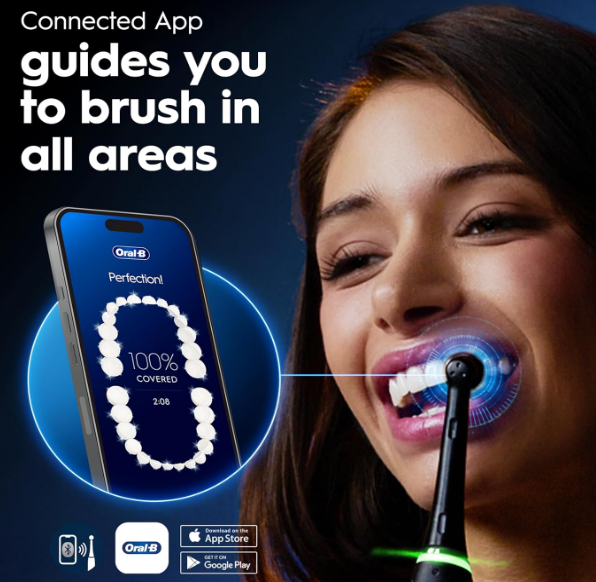
Technology in electric toothbrushes has advanced a lot in recent years. Before, the big question was whether a toothbrush vibrated, oscillated, or had a timer. Today, brands like Oral-B have taken brushing to another level with smart features, pressure sensors, mobile apps, and tracking systems that show how well we are cleaning each part of the mouth.
One of the features that creates the most questions is Oral-B 3D Teeth Tracking, especially when comparing 6-zone vs 16-zone tracking. At first glance, it may seem like a small difference, but in practice, it can significantly change how the toothbrush understands your routine and guides you during brushing.
In this guide, we will explain what this technology means, how it works, the real difference between 6 and 16 zones, which models usually include each system, and whether it is really worth paying more for more precise tracking.
What Is Oral-B 3D Teeth Tracking?
Oral-B 3D Teeth Tracking is a smart feature designed to analyze how you brush your teeth in real time. Instead of simply counting the recommended two minutes, the system tries to detect which areas of the mouth you are cleaning, how much time you spend on each zone, and whether you are leaving any areas untouched.
This technology works together with the Oral-B app and, in some models, with artificial intelligence. The idea is simple: to help you improve your brushing technique without having to guess whether you cleaned your molars, front teeth, inner surfaces, or chewing surfaces properly.
In other words, the toothbrush does not just vibrate and clean. It also acts like a small dental coach that tells you, “Hey, you missed this area a little.”
How Does Brushing Tracking Work?
The system uses sensors built into the toothbrush handle and motion data to interpret the position of the brush inside your mouth. When connected to the app, the user can see a visual representation of the areas that have been brushed.
The app usually shows areas as completed, incomplete, or still pending. This is especially helpful for people who tend to brush the same way every time and forget hard-to-reach areas, such as the back molars or the inner side of the lower teeth.
Real-Time Tracking
One of the main advantages is that the user can receive feedback while brushing. This makes correction immediate. It is not just about seeing a summary afterward, but about adjusting your brushing in the moment.
Support for Building Better Habits
Many people believe they brush well because they complete two minutes. However, time does not always mean full coverage. You may spend too much time on the front teeth and too little on the back areas. That is where 3D tracking becomes valuable.
Oral-B 6 Zones: What Does It Mean?
6-zone tracking divides the mouth into general areas. Usually, these zones represent broad sections such as upper left, upper center, upper right, lower left, lower center, and lower right.
This system is useful because it provides basic guidance on brushing coverage. For many users, especially those who are just starting with a smart electric toothbrush, it may be enough.
Advantages of 6-Zone Tracking
6-zone tracking has several strengths:
- It is easier to understand.
- It is usually found in more affordable models than higher-end options.
- It helps prevent unbalanced brushing.
- It is enough for users who want general guidance.
- It does not require as much interaction with the app.
The big advantage is that it simplifies the experience. If you do not want to deal with overly detailed data, 6 zones can give you a clear idea of whether you are brushing your whole mouth in a fairly balanced way.
Limitations of the 6-Zone System
The problem is that the zones are broader. This means you can “complete” a zone in the app even if you did not clean every tooth surface with the same level of precision.
For example, you might brush the outer side of the upper right molars but not spend enough time on the chewing surface or inner side. The 6-zone system may not detect that detail as accurately.
Oral-B 16 Zones: What Changes?
16-zone tracking is much more specific. Instead of dividing the mouth into large sections, it analyzes more detailed areas. This allows for a more refined reading of your brushing and more precise guidance.
The difference is especially noticeable when you want to know not only which side of the mouth you brushed, but also which surface received enough attention. In other words, the system can provide a more complete evaluation of your brushing coverage.
Why 16 Zones Offer More Precision
With 16 zones, the app can represent the reality of your mouth more accurately. This helps identify small mistakes that the 6-zone system might miss.
For example, if you always forget the inner side of the lower teeth or the back area of the molars, the more advanced tracking system can help you correct that pattern more clearly.
Ideal for Detail-Oriented Users
16-zone tracking is especially useful for people who want to optimize their oral hygiene routine. It can also be interesting for users with braces, implants, crowns, sensitive gums, or a greater concern about dental plaque, although it is always best to follow your dentist’s recommendations.
6 Zones vs 16 Zones: Direct Comparison
The main difference between both systems is the level of detail. The 6-zone system works like a general map, while the 16-zone system feels more like a precise guide for specific areas.
Precision
The 16-zone system clearly wins in precision. It offers a more detailed view and can help detect missed areas more easily.
Ease of Use
The 6-zone system may feel simpler. For users who do not want to look at too much data, it can be more comfortable and less overwhelming.
Price
Models with 16-zone tracking usually belong to higher-end ranges, so they are normally more expensive. If your budget is limited, a model with 6 zones may be a more reasonable option.
Real Value
If you only want to improve your brushing technique a little, 6 zones may be enough. But if you want the most advanced Oral-B experience, the 16-zone system offers a clear advantage.
Is It Worth Paying More for 16 Zones?
It depends on your habits and your budget. If you are consistent, use the timer properly, do not have major dental concerns, and only want basic help, a model with 6 zones can work very well.
But if you want more controlled cleaning, enjoy using the app, want more precise data, and want to know exactly which parts of your mouth you are neglecting, then 16-zone tracking may be worth it.
The key is not to buy technology just because it has more features. The important question is: will you actually use the app? Are you interested in reviewing your brushing coverage? Do you want to correct your technique with visual data? If the answer is yes, 16 zones make a lot of sense.
Who Is 6-Zone Tracking Best For?
The 6-zone system may be ideal for:
- Users buying their first smart electric toothbrush.
- People who want simple guidance.
- Those who do not want to spend too much.
- Users who do not check the app every day.
- People who only need to improve brushing distribution.
It is a good option if you want to move from a basic electric toothbrush to a smarter one without paying for every premium feature.
Who Is 16-Zone Tracking Best For?
The 16-zone system is more recommended for:
- Users who want maximum precision.
- People who use the Oral-B app frequently.
- Those who want to correct missed areas.
- Users with more demanding oral hygiene routines.
- People looking for high-end models such as some advanced Oral-B iO toothbrushes.
It can also be a good choice if you enjoy technology and want a more interactive brushing experience.
Tips to Make the Most of 3D Teeth Tracking
Having a smart toothbrush is not very useful if we use it incorrectly. To get the most out of 3D tracking, it is best to brush calmly, move the toothbrush slowly, and let the brush head do the work.
There is no need to press hard. In fact, many Oral-B iO models include a pressure sensor to warn you if you are applying too much force. The idea is to guide the brush tooth by tooth, cover all surfaces, and check at the end whether the app detected any incomplete areas.
Use the App at Least During the First Few Weeks
You do not necessarily have to use the app forever. But during the first few weeks, it can help you discover patterns. You may notice that you always miss one side, brush too quickly, or do not reach the inner areas properly.
It Does Not Replace Your Dentist
3D tracking is a useful tool, but it does not replace a professional dental checkup. If you have bleeding, pain, sensitivity, or tartar buildup, the right thing to do is consult a dentist.
Conclusion: Oral-B 3D Teeth Tracking With 6 or 16 Zones?
The difference between Oral-B 3D Teeth Tracking with 6 vs 16 zones comes down to precision. The 6-zone system offers general and practical guidance to improve brushing coverage. It is simpler, more accessible, and enough for many users.
The 16-zone system, on the other hand, is designed for those who want a more complete, detailed, and intelligent experience. It helps identify missed areas more accurately and offers more precise guidance inside the app.
If you are looking for value for money, 6 zones may be enough. If you want the most advanced technology and will actually use real-time tracking, 16 zones is the better option. In the end, the best toothbrush is not just the one with more features, but the one that helps you brush better every day.