
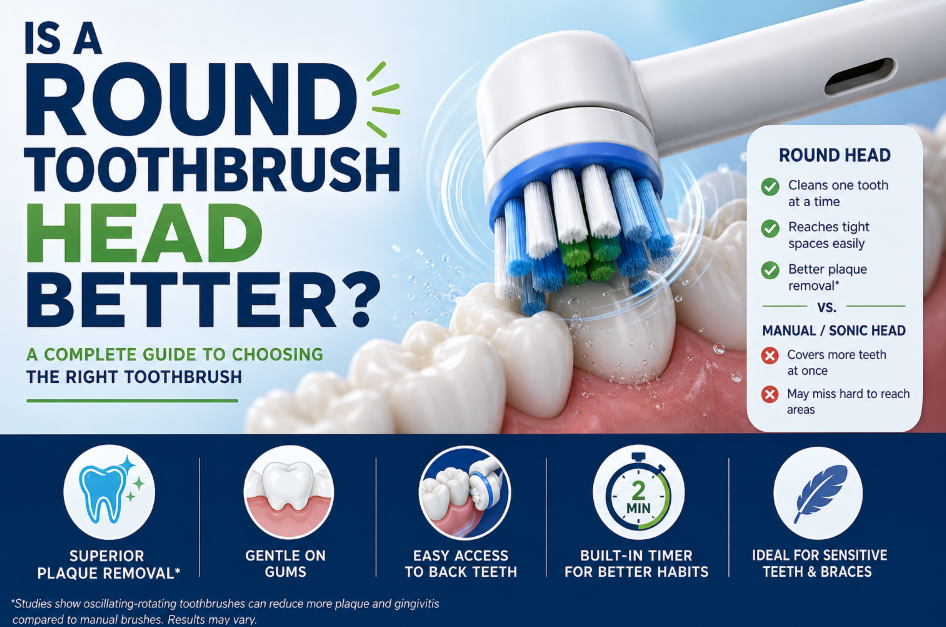
Walk down the oral-care aisle and we face what looks like a small decision with surprisingly large consequences: should we choose a toothbrush with a round head or stick with the familiar elongated design?
Round toothbrush heads are most commonly found on oscillating-rotating electric toothbrushes. Rather than sweeping across several teeth at once, the compact head surrounds one tooth at a time and moves rapidly from side to side. That tooth-by-tooth approach can feel unusually precise—almost like using a small polishing tool instead of a traditional brush.
So, is a round toothbrush head better?
For many people, yes. A small round electric toothbrush head may make it easier to clean individual teeth, reach awkward areas and remove plaque consistently. Research also suggests that oscillating-rotating brushes can provide an advantage over manual toothbrushes and, in some studies, over sonic models for reducing plaque and gingivitis. However, the difference is not magical, and head shape alone does not determine whether a toothbrush works well. Technique, brushing time, pressure, bristle condition and daily consistency remain essential.
Let us take a closer look at how round toothbrush heads work, where they shine, where they fall short and whether one deserves a place beside our bathroom sink.
What Is a Round Toothbrush Head?
A round toothbrush head is a small, circular replacement head typically attached to an electric toothbrush handle. Most models use an oscillating-rotating motion, meaning the head repeatedly turns in one direction and then the other. Some advanced brushes also add pulsations or micro-vibrations.
Unlike a rectangular manual or sonic toothbrush head, which covers two or three teeth at once, a round head is designed to focus on a smaller area. We place it against one tooth, pause briefly and then guide it to the next.
That makes the brushing process more methodical. Instead of scrubbing back and forth as though we were cleaning a kitchen counter, we slowly walk the brush around the mouth.
Round Does Not Automatically Mean Rotating
It is important to separate shape from movement.
A toothbrush may have a round head but use slightly different cleaning technology. Common powered movements include:
- Oscillating: moves rapidly from side to side.
- Rotating: turns in a circular direction.
- Oscillating-rotating: alternates between clockwise and counterclockwise movement.
- Pulsating: moves inward and outward against the tooth.
- Micro-vibrating: adds fine, high-frequency movement.
When people talk about the benefits of a round toothbrush head, they are usually describing the entire cleaning system—not just the circular piece of plastic.
The head, bristle pattern, motor and brushing technique work together like players on the same team.
How Does a Round Toothbrush Head Clean Teeth?
A round electric brush head is intended to wrap partially around the visible surface of each tooth. Its bristles contact the front, edges and gumline while the motor performs much of the cleaning motion.
We do not need to create large circles or aggressively scrub. Instead, we gently position the head at the gumline, allow it to work for a few seconds and then move it slowly across every surface.
This guided approach can reduce one of the biggest problems with manual brushing: inconsistency.
With a manual toothbrush, the quality of the clean depends heavily on how well we move our hand. A powered round head performs thousands of controlled movements while we concentrate mainly on placement.
The Tooth-by-Tooth Advantage
The compact shape encourages us to clean each tooth deliberately.
That can be useful around:
- Back molars
- Crowded lower front teeth
- Dental crowns
- Braces and attachments
- The gumline
- The inside surfaces of teeth
- Partially erupted wisdom teeth
A large rectangular head may feel like a wide paintbrush. It covers more ground quickly, but it may not fit neatly into narrow spaces. A round head behaves more like a detail brush, giving us greater control over where the bristles land.
Is a Round Toothbrush Head Better for Plaque Removal?
Evidence generally supports powered toothbrushes as effective tools for plaque control, although both manual and electric toothbrushes can work when used correctly. The American Dental Association notes that manual and powered toothbrushes are both capable of removing plaque, while also recognizing that powered models may be easier for certain users.
Research comparing technologies has often found favorable results for oscillating-rotating brushes. A published meta-analysis reported that oscillating-rotating toothbrushes produced greater improvements in plaque reduction, gingivitis and transition toward gingival health than manual and sonic brushes across the studies examined.
A separate systematic review also concluded that oscillating-rotating powered brushes were more effective than manual toothbrushes at reducing plaque, gingivitis and bleeding.
However, we should interpret those results sensibly. A statistical advantage does not mean every round-headed brush will outperform every sonic or manual toothbrush in every person’s hands.
The real-world winner is usually the brush we use properly, gently and consistently.
Why the Shape May Help
A round head may support better plaque removal because it:
- Fits closely around individual teeth
- Makes precise gumline placement easier
- Encourages slower, systematic brushing
- Reaches behind molars with less bulk
- Uses automatic movement rather than relying entirely on hand technique
These advantages can help us clean areas that we might otherwise rush past.
Still, no toothbrush head can remove plaque from every tight contact between teeth. We must continue using floss, interdental brushes or another dentist-recommended interdental cleaner.
Round Head vs Sonic Toothbrush: Which Is Better?
This is where the debate becomes more interesting.
A sonic toothbrush usually has an elongated head resembling a traditional manual brush. It moves or vibrates at high speed and is generally guided slowly along the gumline. A round oscillating-rotating brush, by contrast, focuses on one tooth at a time.
Some reviews and clinical studies show a modest advantage for oscillating-rotating technology in reducing plaque and gingivitis. A 2024 review of electric toothbrush technologies also found a tendency for oscillating-rotating brushes to remove more plaque between teeth in the studies assessed.
Yet not every analysis concludes that one powered technology is decisively superior. Some researchers have noted that measured differences can be small and may not always translate into dramatic long-term clinical differences for every user.
In practical terms, both can be excellent.
Round Oscillating-Rotating Heads May Suit Us When We Want
- A small brush head
- Tooth-by-tooth guidance
- A stronger polishing sensation
- Easy access around back teeth
- A familiar electric-brush routine
- More help controlling brushing movement
Sonic Heads May Suit Us When We Prefer
- A shape similar to a manual toothbrush
- A sweeping gumline technique
- A lighter vibrating sensation
- Fewer pauses between individual teeth
- A larger head that covers more surface area
Neither design deserves a universal crown. The best choice depends on our mouth, comfort and ability to use the brush correctly.
Is a Round Toothbrush Head Better Than a Manual Toothbrush?
A round electric head can be better than a manual toothbrush for people who struggle with technique or consistency.
The motor creates the cleaning movement, while built-in timers help us brush for the recommended duration. Many models also include pressure sensors that warn us when we push too hard.
Manual brushes, however, remain entirely capable tools. They are inexpensive, portable, quiet and easy to replace. The ADA confirms that both manual and powered toothbrushes can remove plaque effectively.
The key difference is effort.
A manual toothbrush asks us to control angle, pressure, movement and timing. A powered round head handles much of the movement and leaves us to guide it.
When the Powered Option Has a Clear Practical Edge
A round electric toothbrush may be especially helpful for:
- People with arthritis
- Users with reduced hand strength
- Older adults
- Children learning to brush
- People wearing orthodontic appliances
- Anyone who brushes too quickly
- Users who struggle to maintain consistent movement
Powered brushes may be easier for people with dexterity challenges or dental appliances, according to the ADA.
Does a Round Head Reach Back Teeth More Easily?
Usually, yes.
The smaller profile can fit behind the last molars and along the inside surfaces of the lower teeth more comfortably than a long, bulky head.
Think of trying to park a compact car versus a large van in a narrow space. Both vehicles may reach the destination, but one requires less maneuvering.
A round brush head can also make it easier to angle the bristles near:
- The back of the upper molars
- The tongue-facing surfaces of lower teeth
- Crowded areas
- Teeth next to dental work
- The gumline behind canine teeth
Nevertheless, a small head only helps when we actually guide it into those areas. Speeding through the routine will erase much of the design advantage.
Are Round Toothbrush Heads Better for the Gumline?
They can be.
Their compact shape makes it easier to place the bristles partly on the tooth and partly along the gumline. This is important because plaque frequently accumulates where the tooth and gum meet.
However, better access does not give us permission to press harder.
Gums do not need to be scrubbed like stained tile. Gentle contact is enough. Excessive force may irritate soft tissue, bend bristles prematurely and contribute to gum recession or wear near the neck of the tooth.
Pressure Matters More Than Power
A round head may feel powerful because of its movement, but the motor should do the work.
We should:
- Wet the brush head and apply a small amount of fluoride toothpaste.
- Place the head against a tooth at the gumline.
- Use light contact rather than heavy pressure.
- Hold it in place briefly.
- Guide it slowly to the next tooth.
- Clean the outer, inner and chewing surfaces.
- Follow the full two-minute timer.
When a brush has a pressure sensor, we should pay attention to it. A warning light is not a challenge to overcome—it is the toothbrush telling us to relax our grip.
Can a Round Toothbrush Head Damage Gums or Enamel?
The shape itself is not normally the problem. Poor technique is.
Any toothbrush can cause irritation when used with excessive pressure, hard bristles or aggressive scrubbing. An electric brush may tempt us to press down because the vibration creates the impression that greater force will produce a deeper clean.
It usually does not.
A soft-bristled round head used gently should be suitable for most people. Those with gum recession, dental sensitivity, recent surgery or enamel wear should follow personalized advice from a dentist or dental hygienist.
Signs We May Be Brushing Too Hard
Watch for:
- Bristles spreading outward quickly
- Soreness after brushing
- Bleeding that persists
- Increasing tooth sensitivity
- Notches near the gumline
- Gum tissue appearing to recede
- A pressure warning activating frequently
Occasional gum bleeding may also indicate gingivitis rather than simply excessive pressure. Persistent bleeding deserves professional assessment instead of self-diagnosis.
Are Round Toothbrush Heads Better for Sensitive Teeth?
Not automatically, but they can work very well.
Sensitivity depends on several factors, including gum recession, exposed dentin, cavities, cracked teeth, enamel erosion and brushing pressure. Changing head shape will not solve every cause.
A round head may help because we can control its placement carefully. Many electric handles also offer a sensitive mode with reduced intensity.
For a gentler routine, we should look for:
- Soft or extra-soft bristles
- A pressure sensor
- A lower-intensity setting
- A small head
- A visible replacement indicator
- Compatible sensitive-care heads
We should avoid assuming that a brush must feel aggressive to be effective. A calm, controlled clean can outperform a frantic one.
Do Round Toothbrush Heads Work Well With Braces?
They can be highly useful around braces, although cleaning requires patience.
The compact head can be positioned above and below brackets, around wires and near the gumline. Powered brushes may also help people with orthodontic appliances who find manual brushing difficult.
The challenge is that no standard toothbrush head can perfectly clean under every wire or between every bracket.
A Better Braces Routine
We can combine the round head with:
- Interdental brushes
- Floss threaders
- Orthodontic floss
- A water flosser where recommended
- Fluoride toothpaste
- Regular professional cleaning
The round head handles the main surfaces. Interdental tools finish the detail work.
Are Round Toothbrush Heads Good for Children?
A small round head may suit children because it can fit comfortably around smaller teeth and requires less complex hand movement.
Some healthcare guidance recommends small oscillating heads for children in situations where an electric toothbrush is appropriate.
Still, age recommendations vary among products. Parents should check the manufacturer’s instructions and follow the child’s dental professional’s advice.
Children also require supervision. A timer, colourful light or brushing app may make the routine more engaging, but technology cannot replace adult guidance.
What Matters Most for a Child’s Brush
We should prioritize:
- An age-appropriate head
- Soft bristles
- A comfortable handle
- Gentle intensity
- Adult supervision
- Fluoride toothpaste in the recommended amount
- A routine the child will actually follow
A technically impressive toothbrush that frightens or overwhelms a child will spend more time in the drawer than in the mouth.
What Are the Disadvantages of a Round Toothbrush Head?
Round heads have plenty of strengths, but they are not perfect.
1. They Require a Different Technique
People accustomed to manual brushing often continue scrubbing with the electric head. That can create unnecessary pressure and make the experience uncomfortable.
We need to slow down, pause and let the motor work.
2. Replacement Heads Can Be Expensive
Powered brush heads usually cost more than basic manual toothbrushes. Prices also vary considerably between original-brand and compatible replacements.
A cheaper handle is not always cheaper over several years if its replacement heads are costly.
3. The Small Head Can Feel Slow
Because it cleans one tooth at a time, some users feel that the process is tedious. A sonic head may seem more natural to people who prefer a smooth sweeping motion.
4. The Sensation May Be Too Intense
Oscillation near the front teeth can feel noisy or ticklish. People with sensory sensitivity may prefer a quieter manual brush or a gentler sonic model.
5. Compatibility Can Be Confusing
Not every round head fits every handle. Even brushes from the same manufacturer may use different attachment systems.
Before buying replacements, we should confirm:
- Brand
- Brush series
- Handle model
- Head attachment type
- Recommended age group
- Intended cleaning mode
How to Use a Round Toothbrush Head Correctly
A good toothbrush used badly becomes an expensive mistake. Fortunately, the correct technique is simple.
Step 1: Divide the Mouth Into Sections
Most electric timers divide the two-minute session into four 30-second periods:
- Upper right
- Upper left
- Lower right
- Lower left
This structure reduces the chance of polishing the front teeth repeatedly while neglecting the back.
Step 2: Start at the Gumline
Place the bristles against the tooth with some contact along the edge of the gum. Use only light pressure.
Step 3: Pause on Each Tooth
Allow the head to remain against each surface briefly. Move slowly rather than scrubbing.
Step 4: Follow the Tooth’s Shape
Tilt and guide the head so it contacts the outer, inner and chewing surfaces.
Step 5: Clean Behind the Front Teeth
Hold the head vertically where needed. This area often collects tartar and deserves careful attention.
Step 6: Spit, but Follow Professional Advice About Rinsing
Use fluoride toothpaste and follow local dental guidance regarding rinsing after brushing. Avoid swallowing toothpaste.
Step 7: Clean and Air-Dry the Head
Rinse away toothpaste residue, shake off excess water and leave the brush upright where it can dry.
How Often Should We Replace a Round Toothbrush Head?
A commonly used rule is to replace the head about every three months, or sooner when the bristles become frayed, flattened or discoloured.
The exact schedule depends on:
- Brushing pressure
- Frequency of use
- Bristle quality
- Whether the head has indicator bristles
- Manufacturer instructions
- Illness or contamination concerns
- Orthodontic appliances, which may wear bristles faster
A worn brush head loses precision. Once the bristles begin pointing sideways, they no longer contact teeth as intended.
A replacement reminder is useful, but our eyes are useful too.
What Features Matter More Than Head Shape?
Round versus oval may grab our attention, but several other features can influence everyday results just as much—or more.
Soft Bristles
Soft bristles clean effectively while reducing the temptation to attack the gumline.
Pressure Sensor
This is one of the most practical features available. It helps us recognize excessive force in real time.
Two-Minute Timer
Many people overestimate how long they brush. A timer removes the guesswork.
Quadrant Pacing
A 30-second signal encourages even coverage across the mouth.
Comfortable Handle
A handle should feel secure without requiring a tight grip.
Affordable Replacement Heads
A brush is only useful when we can maintain it. Replacement cost and availability deserve serious consideration.
Simple Controls
Ten brushing modes look impressive on the box, but many of us use only one or two. Reliability and comfort often matter more than a forest of icons.
Who Is Most Likely to Benefit From a Round Head?
A round oscillating-rotating toothbrush may be particularly suitable for people who:
- Want a precise, tooth-by-tooth clean
- Regularly miss back molars
- Have limited hand dexterity
- Wear braces or retainers
- Brush too quickly
- Like strong visual or pressure feedback
- Struggle with manual brushing technique
- Prefer a small head inside the mouth
Healthcare guidance for people requiring brushing assistance also sometimes recommends electric brushes with oscillating-rotating movement because the powered action and larger handle can simplify oral care.
Who Might Prefer an Elongated or Sonic Head?
A round head is not the ideal choice for everyone.
An elongated sonic head may feel better for people who:
- Prefer the shape of a manual toothbrush
- Dislike strong oscillating sensations
- Want a smoother sweeping motion
- Have sensory sensitivity
- Prefer longer battery life in certain models
- Feel impatient cleaning one tooth at a time
A manual brush may remain the best practical option for someone who wants a low-cost, silent brush for travel or who already has excellent technique.
The goal is not to own the most advanced toothbrush. The goal is to achieve a consistently clean mouth without damaging teeth or gums.
How Do We Choose the Best Round Toothbrush Head?
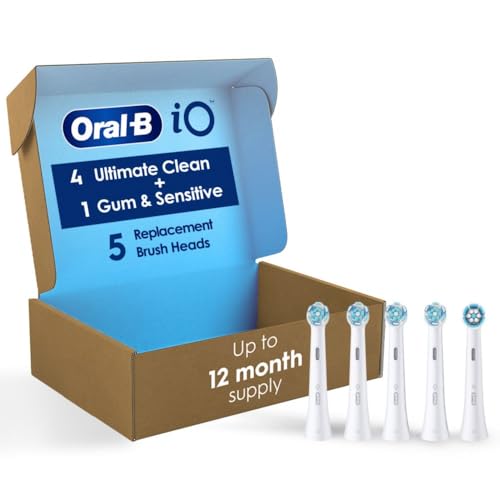
Replacement heads often promise whitening, deep cleaning, gum care, precision cleaning or premium polishing. Those labels can make a simple purchase feel like selecting equipment for a space mission.
We can simplify the decision.
Choose a Standard Soft Head When
- We are new to electric brushing
- We want everyday plaque removal
- We have no special dental concerns
- We prefer an affordable replacement
Choose a Sensitive Head When
- Brushing feels uncomfortable
- We have gum recession
- Our dentist recommends gentler care
- Standard bristles feel too firm
Choose a Compact Head When
- Our mouth feels small
- Back teeth are difficult to reach
- We have crowded teeth
- A standard round head feels bulky
Choose an Orthodontic or Interspace Head When
- We wear braces
- We need to clean around attachments
- A dental professional recommends targeted brushing
Specialized heads can help, but they do not replace professional diagnosis or treatment.

Common Mistakes When Using a Round Electric Head
The technology is clever, but it cannot stop every human habit.
Scrubbing Back and Forth
The head already moves. We should guide it rather than duplicating the motor’s action.
Pressing Too Hard
More pressure does not equal more plaque removal. It often means more irritation.
Skipping Inner Surfaces
Front-facing teeth receive the spotlight. The tongue-facing surfaces often receive whatever time remains.
Moving Too Quickly
A quick pass does not allow the bristles to work around each tooth.
Ignoring the Gumline
Plaque does not politely remain in the centre of the tooth. We must clean where teeth and gums meet.
Keeping the Same Head Too Long
A worn head may look harmless, but bent bristles lose accuracy.
Assuming Electric Means Effortless
The toothbrush supplies movement, not judgment. We still control placement, timing and coverage.
Is a Round Toothbrush Head Worth the Extra Cost?
For many users, it is.
The value does not come from the shape alone. It comes from the combination of a compact head, powered movement, timer, pressure guidance and easier technique.
A round electric head may be worth paying for when it helps us:
- Brush for the full two minutes
- Reach neglected areas
- Reduce plaque more consistently
- Avoid aggressive manual scrubbing
- Maintain a routine despite limited dexterity
It may not be worth the cost when replacement heads strain the budget or when we dislike the sensation enough to avoid using it.
An unused premium toothbrush is worse than a basic brush used correctly twice a day.
The Final Verdict: Is a Round Toothbrush Head Better?
A round toothbrush head can be better, particularly when it is part of a well-designed oscillating-rotating electric toothbrush.
Its small size supports precise placement, tooth-by-tooth cleaning and easier access to awkward areas. Research has repeatedly found that oscillating-rotating powered toothbrushes can reduce plaque and gingivitis more effectively than manual brushes, with some analyses also reporting advantages over sonic technology.
But we should not confuse “better in studies” with “automatically perfect.”
Head shape is one piece of the puzzle. Soft bristles, light pressure, fluoride toothpaste, two full minutes, interdental cleaning and regular dental visits remain central to good oral health.
The best toothbrush is not necessarily the roundest, fastest or most expensive. It is the one that fits our mouth, supports good technique and makes us want to return to the sink every morning and night.
Frequently Asked Questions
1. Is a round toothbrush head better for removing plaque?
A round oscillating-rotating head may remove more plaque than a manual toothbrush, particularly when used correctly. Some research also reports better plaque and gingivitis outcomes than sonic brushes, although the size of the advantage varies among studies.
2. Should a round toothbrush head touch the gums?
The bristles should gently contact the gumline, but we should not press deeply into the gums. Position the head partly against the tooth and partly near the gum margin, using light pressure.
3. Is a round or oval electric toothbrush head better?
A round head often offers more precise tooth-by-tooth cleaning, while an oval sonic head covers a larger area and may feel more familiar. Both can work well. Comfort, technique and consistency should guide the choice.
4. Can we use a round toothbrush head every day?
Yes. A soft-bristled round head is designed for routine daily use when compatible with the handle and used according to the manufacturer’s instructions. People with dental surgery, severe sensitivity or specific gum conditions should follow professional advice.
5. How long should we hold a round brush head on each tooth?
There is no need to count rigidly for every tooth. Move slowly enough to clean the outer, inner and chewing surfaces while completing a full two-minute session. Many electric brushes signal every 30 seconds to help divide the mouth evenly.