
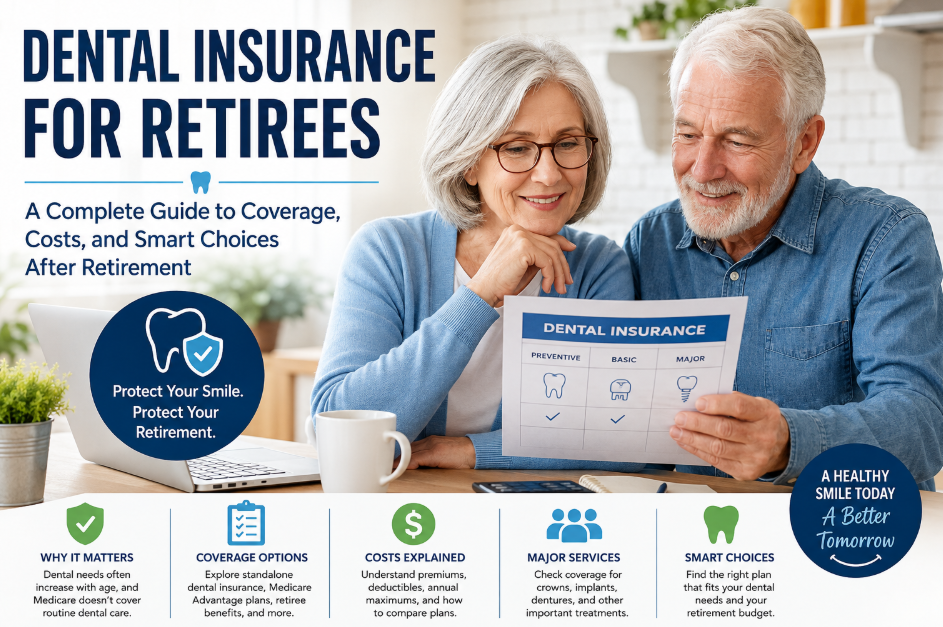
Retirement changes plenty of things. The morning alarm disappears, weekdays start feeling suspiciously like Saturdays, and the way we pay for healthcare can change almost overnight. Dental care is one of those expenses that can catch retirees off guard.
That is exactly why dental insurance for retirees deserves more attention than it often gets.
Many of us spend decades receiving dental benefits through an employer and barely think about what cleanings, fillings, crowns, or X-rays actually cost. Then retirement arrives, employer coverage disappears, and suddenly we’re responsible for figuring out dental care ourselves.
The problem becomes especially important around age 65. Original Medicare provides extensive medical coverage, but routine dental care generally isn’t included. Medicare states that, in most situations, it does not pay for routine cleanings, fillings, extractions, dentures, or dental implants. Certain dental services connected directly to medically necessary treatments can qualify for Medicare coverage, but those are exceptions rather than ordinary dental benefits.
So what should retirees do?
Fortunately, we have several options. Standalone dental insurance, Medicare Advantage plans with dental benefits, former-employer retiree coverage, dental discount programs, and even paying cash can all make sense depending on our teeth, budget, and expected dental work.
The key is understanding that the cheapest plan isn’t automatically the best plan. Sometimes a $25 monthly premium saves money. Sometimes it merely adds another bill.
Let’s break it down.
Why Dental Insurance Becomes More Important After Retirement
Teeth don’t retire when we do.
In fact, dental needs may become more complicated as we age. Old fillings eventually wear down. Crowns can crack. Gum problems may become more noticeable. Teeth that survived perfectly well for decades can suddenly require expensive work.
Retirement can also change how predictable our finances are.
While someone earning a regular salary might absorb an unexpected $1,500 dental bill, a retiree living primarily on Social Security, pensions, investment withdrawals, or other fixed income may prefer predictable monthly expenses.
That makes dental coverage attractive.
Instead of facing every dental expense alone, insurance can help turn irregular costs into something more manageable. But there’s an important catch: dental insurance doesn’t usually function like major medical insurance.
Dental Insurance Isn’t the Same as Health Insurance
We often think insurance exists primarily to protect us from catastrophic expenses. Dental plans tend to work differently.
Many dental insurance policies focus heavily on routine and preventive care while placing relatively modest limits on how much they’ll pay each year.
A typical structure may divide services into categories such as:
- Preventive care, including examinations, routine cleanings, and X-rays
- Basic services, such as fillings and uncomplicated extractions
- Major services, such as crowns, bridges, dentures, and certain oral surgeries
- Orthodontic or specialty benefits, when offered
Some policies use percentage-based cost sharing. You may occasionally see structures informally described as “100-80-50,” meaning preventive services receive the highest reimbursement, basic procedures receive less, and major services receive less again.
However, coverage varies substantially between plans, so we shouldn’t assume any specific procedure or percentage is covered until we’ve checked the actual policy.
The Annual Maximum Can Matter More Than the Premium
Here’s where dental insurance gets interesting.
A plan may cover 50% of an expensive crown, but if we’ve already reached the plan’s annual benefit maximum, additional treatment may receive little or no insurance payment until the benefit period resets.
That’s why comparing dental plans based solely on monthly premiums is like choosing a car based solely on its paint color.
We need the whole picture.
Does Medicare Cover Dental Care for Retirees?
This is one of the biggest misconceptions surrounding retirement healthcare.
Original Medicare generally does not provide routine dental insurance.
Medicare’s current guidance states that it generally doesn’t cover ordinary dental services such as cleanings, fillings, routine extractions, dentures, and implants.
There are limited exceptions.
For example, Medicare may pay for certain dental examinations or treatments when they’re directly connected to specific Medicare-covered medical treatments, including certain organ transplants, cancer treatments, heart valve replacement, or dialysis-related care.
That’s very different from having everyday dental coverage.
What About Medicare Part A and Part B?
Medicare Part A primarily relates to hospital insurance, while Part B generally covers outpatient medical services.
Neither should be viewed as a replacement for routine dental insurance.
There can be circumstances in which Medicare pays for qualifying dental-related services connected with medically necessary treatment, but retirees shouldn’t expect Part A or Part B to pay for their twice-yearly cleaning, routine cavity treatment, or new dentures simply because they’re enrolled in Medicare.
What About Medicare Advantage Dental Benefits?
This is where retirees have another option.
Some Medicare Advantage plans include additional benefits that Original Medicare doesn’t routinely provide, and dental benefits are commonly among the extras retirees investigate.
But the word “dental” printed on a plan brochure doesn’t tell us enough.
One plan might concentrate primarily on preventive services. Another may contribute toward fillings, crowns, dentures, or other procedures. Provider networks, authorization rules, copayments, exclusions, and annual benefit limits can also differ.
Before choosing a Medicare Advantage plan because of its dental benefits, we should ask:
How much dental coverage are we actually receiving, and can we use our preferred dentist?
That question can save a lot of frustration later.
Main Types of Dental Coverage for Retirees
Retirees aren’t limited to a single route. Several different arrangements can work.
1. Standalone Dental Insurance
Standalone dental policies are purchased separately from medical insurance.
They’re particularly useful for retirees who have Original Medicare but want routine dental benefits, or for anyone whose other health coverage doesn’t include adequate dental care.
Depending on the policy, coverage may include preventive, basic, and major dental procedures.
Standalone plans can also offer greater flexibility than simply accepting whatever dental benefit comes bundled with another healthcare plan.
However, we need to examine waiting periods, deductibles, annual maximums, networks, exclusions, and coverage percentages.
2. Medicare Advantage Plans With Dental Coverage
Medicare Advantage can combine Medicare-covered medical services with additional benefits that may include dental care.
For some retirees, keeping these benefits under one plan feels wonderfully simple.
But convenience shouldn’t override the rest of the healthcare decision.
Choosing a Medicare Advantage plan merely because it advertises attractive dental coverage would be backwards. The plan’s hospitals, physicians, drug coverage, costs, geographic service area, and other medical benefits usually deserve greater weight.
Think of dental coverage as one piece of the puzzle rather than the entire puzzle.
3. Employer or Union Retiree Dental Benefits
Before purchasing anything, check whether a former employer offers retiree benefits.
Some employers or unions continue providing health or supplemental benefits after retirement.
Medicare specifically advises retirees with former-employer coverage to understand how those benefits coordinate with Medicare and to consult their benefits administrator about the details of the plan.
Dental coverage may be included or available separately depending on the employer.
Don’t assume the benefits remain identical to those we had while working. Retirement benefits can have different rules, premiums, networks, and cost sharing.
4. Dental Discount Plans
A dental discount plan technically isn’t insurance.
Instead, participating dentists agree to provide certain services at negotiated or discounted rates to members.
We typically pay a membership fee and then pay the discounted bill ourselves.
These programs can be attractive when insurance waiting periods or annual maximums make conventional coverage less useful.
But savings depend heavily on participating dentists and negotiated rates.
5. Paying Dental Costs Out of Pocket
Sometimes the simplest option is no dental insurance at all.
That might sound reckless, but not necessarily.
Imagine someone with excellent oral health who needs little beyond two cleanings and occasional X-rays. If the annual insurance premium plus deductible approaches what routine care would cost anyway, self-paying may be reasonable.
Conversely, someone expecting crowns, periodontal treatment, dentures, or extensive restorative work may value insurance far more.
Insurance is a financial tool, not a requirement for every retiree.
How Much Does Dental Insurance for Retirees Cost?
There’s no universal price.
Premiums depend on the insurer, location, plan structure, coverage level, network, and sometimes the number of people enrolled.
Instead of fixating on the monthly premium, we should calculate the annual cost of having and using the plan.
Suppose one policy costs significantly less every month but has:
- A lower annual benefit maximum
- A higher deductible
- Limited major-service coverage
- A long waiting period
- A smaller dentist network
Another plan might have a higher premium but substantially better benefits.
Which one is cheaper?
We can’t know from the premium alone.
Calculate the Real Annual Cost
A useful comparison looks something like this:
Annual premiums + deductible + expected copayments or coinsurance – expected insurance benefits.
We don’t need a spreadsheet worthy of Wall Street.
Even a rough calculation can reveal surprising results.
A seemingly inexpensive dental policy can become expensive once we discover it barely contributes toward the treatments we’re likely to need.
The Seven Features Retirees Should Compare
Dental insurance contracts aren’t exactly beach reading, but seven details deserve particular attention.
1. Monthly Premium
This is what we pay merely to keep the policy active.
Multiply it by 12.
A $40 premium isn’t just $40. It’s $480 per year before we’ve received any treatment.
That annual perspective makes comparison easier.
2. Annual Deductible
The deductible represents an amount we may need to pay before certain insurance benefits begin.
Some preventive services may operate differently, depending on the plan.
Look at both the deductible amount and which procedures it applies to.
3. Annual Benefit Maximum
This is among the most important numbers in dental insurance.
The annual maximum is generally the most the insurance plan will contribute toward covered care within the benefit year.
Imagine needing several expensive procedures within the same year. Once we’ve exhausted the annual insurance benefit, we could become responsible for the remaining covered expenses despite continuing to pay monthly premiums.
That’s why retirees expecting substantial dental work should pay close attention to higher benefit limits.
4. Waiting Periods
A waiting period means coverage for certain procedures doesn’t begin immediately.
Preventive care might start relatively quickly while major procedures could require a longer period before becoming eligible.
That matters tremendously if we already know a crown or other expensive treatment is coming.
Buying dental insurance after the dentist has identified major work and assuming the policy will instantly pay for it can lead to disappointment.
5. Coverage for Major Dental Work
This category deserves extra scrutiny because major procedures are where dental bills can become painful.
Check whether the plan covers things such as:
- Crowns
- Bridges
- Dentures
- Root canal treatment
- Oral surgery
- Periodontal procedures
- Dental implants
Don’t merely ask whether they’re “covered.”
Ask how much they’re covered, what limitations apply, and whether there’s a waiting period.
6. Dentist Network
A fantastic policy becomes far less fantastic if our dentist doesn’t accept it.
Before enrolling, search the insurer’s provider directory and, ideally, confirm participation directly with the dental office.
Networks change, websites can lag behind reality, and dentists may participate with one insurance product but not another from the same company.
7. Treatment Frequency Limits
Insurance policies may limit how frequently they cover specific services.
For example, the policy may define intervals for exams, X-rays, cleanings, replacement crowns, dentures, or other procedures.
If we’ve recently had treatment, replacement-frequency rules can become surprisingly important.
Dental Insurance for Retirees With Existing Dental Problems
Here’s where shopping becomes more complicated.
Suppose we’ve already been told that we need two crowns, periodontal treatment, and perhaps an implant.
We might think, “Perfect. I’ll buy insurance first.”
Unfortunately, dental insurance isn’t a magic coupon.
Waiting periods, annual maximums, exclusions, missing-tooth provisions, replacement rules, and coinsurance can dramatically reduce the amount a newly purchased plan contributes.
Compare Insurance Against the Actual Treatment Plan
Ask the dentist for a written treatment estimate.
Then compare that estimate against each policy.
Instead of vaguely asking whether a plan is “good,” calculate what it might pay for the procedures we realistically expect.
That converts marketing language into useful numbers.
Ask About Treatment Timing
When medically and dentally appropriate, treatment schedules can sometimes span benefit years.
Because annual insurance limits may reset, treatment timing could influence how benefits are used.
That doesn’t mean we should postpone necessary care simply to manipulate insurance benefits. Clinical decisions belong between us and our dentist.
But understanding insurance timing can still help us plan responsibly.
Are Dental Implants Covered for Retirees?
Implants have become increasingly important to retirees who want alternatives to conventional dentures or bridges.
Unfortunately, implant coverage varies substantially.
A dental plan might:
- Cover part of implant-related treatment
- Cover the crown but not every component
- Exclude implants
- Apply a waiting period
- Restrict benefits through annual limits
- Require use of in-network providers
And remember: Original Medicare generally doesn’t cover dental implants as routine dental treatment.
If implants are a priority, search specifically for implant provisions rather than assuming a broad “major dental” category includes everything.
What About Dentures?
Dentures can represent a major retirement expense.
Once again, Original Medicare generally doesn’t pay for dentures as routine dental items.
Private coverage may help, but we need to investigate:
- Whether dentures are included
- Percentage or copayment structure
- Annual benefit maximum
- Replacement frequency restrictions
- Denture adjustments or repairs
- Network requirements
- Waiting periods
A plan that looks generous for cleanings may provide limited protection against the cost we’re actually worried about.
PPO vs. HMO-Style Dental Plans for Retirees
Dental networks can influence both freedom and cost.
Dental PPO Plans
PPO-style dental coverage often gives members greater freedom to choose dentists, although using an in-network provider can produce better negotiated rates or benefits.
This flexibility appeals to retirees who already have a dentist they trust.
The downside?
Premiums can sometimes be higher, and out-of-network expenses may be less predictable.
Dental HMO or Managed-Network Plans
Other dental plans use more restrictive provider arrangements.
These can potentially offer predictable fees or lower premiums, but provider choice may be narrower.
For retirees who travel frequently or divide their year between different states, geographic network limitations deserve particular attention.
Should Couples Buy Dental Insurance Together?
Not automatically.
Retired spouses may have dramatically different dental needs.
One person may have nearly perfect teeth and require little beyond preventive care. The other may have crowns, periodontal disease, dentures, or upcoming restorative work.
If a family policy is available, compare its total economics against separate coverage.
The cheapest household strategy isn’t always both people buying identical insurance.
Dental Insurance Before and After Age 65
We often associate retirement with 65 because Medicare eligibility commonly begins around that age. Medicare’s Initial Enrollment Period generally spans seven months: the three months before the month someone turns 65, the birthday month, and the three months afterward.
But retirement and Medicare eligibility aren’t the same thing.
Someone might retire at 60, 63, 67, or 72.
Retiring Before Medicare Eligibility
Retiring early can create a healthcare coverage gap.
Dental insurance may need to be purchased separately from whatever medical coverage we use before Medicare.
Check whether:
- COBRA or another continuation arrangement includes dental benefits
- A spouse’s employer plan remains available
- Individual dental coverage makes financial sense
- A dental discount plan provides better value
Retiring at or After Medicare Eligibility
At this point, dental planning becomes part of the broader Medicare decision.
Former-employer retiree coverage also deserves careful attention. Medicare notes that retirees may need Medicare Part A and Part B to receive full benefits from some former-employer retiree health arrangements, so coordinating benefits with the former employer’s administrator is important.
How to Choose the Best Dental Insurance for Retirement
Forget finding the universally “best” company.
Find the best arrangement for our expected dental needs.
Start with three questions.
How Healthy Are Our Teeth Right Now?
Someone with decades of stable dental health might prioritize:
- Low premiums
- Preventive care
- A strong local dentist network
Someone with extensive restorative work may prioritize:
- Higher annual benefits
- Major-service coverage
- Shorter waiting periods
- Implant or denture benefits
- Broad provider access
What Work Do We Expect During the Next 12–24 Months?
We can’t predict everything.
But we often know if a dentist is monitoring a cracked tooth, aging crown, gum problem, missing tooth, or deteriorating bridge.
Expected treatment changes the economics dramatically.
How Much Financial Risk Can We Comfortably Absorb?
Two retirees with identical teeth may choose completely different plans.
One may have enough savings to comfortably pay a $2,000 dental bill and therefore prefer low premiums.
Another may value predictable monthly costs and insurance participation even if the long-term mathematical savings are modest.
Both choices can be reasonable.
Personal finance isn’t merely about minimizing expected costs. It’s also about managing uncertainty.
Common Mistakes When Buying Dental Insurance for Retirees
The easiest way to choose poorly is to focus on one attractive number.
A low premium can distract us from everything else.
Common mistakes include:
- Choosing solely by monthly premium
- Assuming Original Medicare covers routine dentistry
- Ignoring the annual maximum
- Failing to check whether a dentist is in network
- Overlooking waiting periods
- Assuming implants are automatically covered
- Not reading denture replacement limitations
- Focusing on cleaning benefits while ignoring major dental work
- Buying insurance after major treatment has already been scheduled without checking eligibility
- Forgetting to compare insurance against simply paying cash
The lesson is simple: coverage matters more than branding.
Is Dental Insurance Worth It for Retirees?
Sometimes yes.
Sometimes no.
The answer depends on how we expect to use it.
Consider dental insurance more seriously when we:
- Want predictable dental expenses
- Regularly use preventive services
- Expect fillings or restorative treatment
- Want partial protection against larger dental bills
- Prefer negotiated network rates
- Don’t have substantial employer retiree dental benefits
Self-paying may deserve consideration when we:
- Have very limited dental needs
- Have substantial savings earmarked for healthcare
- Can’t find a suitable network
- Would pay nearly as much in premiums as routine services cost
- Face procedures excluded by available insurance policies
The smartest approach is comparing actual numbers.
How to Compare Dental Plans Step by Step
Here’s a simple framework we can use before enrolling.
- Ask our dentist what treatment may be needed during the next year.
- Request approximate cash prices for those procedures.
- Collect dental plan summaries from several available options.
- Calculate each plan’s annual premium.
- Check deductibles and annual benefit maximums.
- Verify the dentist’s network status.
- Review waiting periods.
- Examine major-service coverage carefully.
- Check limitations for implants, dentures, crowns, and replacement work.
- Estimate what the insurer might actually pay.
- Compare the total expected cost against paying cash.
This takes a little more effort than clicking the cheapest option on a comparison page, but it can prevent expensive surprises.
Can Retirees Use Dental Insurance While Traveling?
Retirement often means travel.
Maybe we’re visiting grandchildren three states away. Maybe we spend winters somewhere warm. Maybe we’re finally taking the cross-country road trip we’ve discussed for 20 years.
Network coverage suddenly matters.
A large PPO network may be more convenient for retirees who move frequently, while a highly localized dental plan may work perfectly for someone who rarely leaves home.
Check how the policy handles emergency dental care outside the service area as well.
Dental Insurance and a Fixed Retirement Budget
Retirement planning frequently focuses on housing, groceries, medical premiums, utilities, and travel.
Dental care deserves its own line.
Even if we decide against insurance, setting aside money for dental expenses can reduce financial stress.
Consider creating an annual dental budget covering:
- Routine exams and cleanings
- X-rays
- Insurance premiums
- Deductibles
- Expected copayments
- Emergency dental care
- Replacement fillings or crowns
- Denture maintenance
- A reserve for unexpected procedures
Teeth have terrible timing. A cracked crown rarely checks our vacation calendar before making an appearance.
When a Dental Discount Plan May Be Better Than Insurance
Discount plans can sometimes work well for retirees who dislike conventional insurance limitations.
Because these programs aren’t insurance, they operate differently.
Instead of the insurer reimbursing treatment, participating dental offices provide services at negotiated prices.
That can make them attractive when:
- We need treatment soon
- Insurance waiting periods are problematic
- Annual insurance maximums seem restrictive
- Our preferred dentist participates
- We want straightforward discounted pricing
But we should compare actual fees rather than assuming the word “discount” guarantees savings.
Why Preventive Dental Care Still Matters in Retirement
Dental insurance discussions easily become obsessed with crowns and implants.
Preventive care deserves equal attention.
Regular dental visits can identify small problems before they become expensive ones.
A tiny cavity is one thing.
A neglected tooth that eventually requires extensive restorative work is another.
Good oral hygiene also remains our first line of defense. Insurance helps pay bills; it doesn’t brush our teeth.
Electric toothbrushes, interdental cleaning, fluoride toothpaste when appropriate, regular professional care, and consistent home hygiene can potentially make our dental budget far more pleasant over the years.
Insurance Is the Backup—Daily Care Is the Foundation
It’s tempting to believe buying a better policy solves the dental problem.
It doesn’t.
Think of dental insurance as the umbrella.
Daily oral hygiene is the roof.
The stronger the roof, the less frequently we need the umbrella.
Final Thoughts on Dental Insurance for Retirees
Choosing dental insurance for retirees isn’t about finding the plan with the flashiest brochure or the cheapest monthly premium.
It’s about matching coverage to reality.
We should begin by understanding one crucial fact: Original Medicare generally doesn’t cover routine dental services such as cleanings, fillings, dentures, and implants.
From there, retirees can explore standalone dental insurance, Medicare Advantage dental benefits, former-employer retiree coverage, discount plans, or self-funded dental care.
The right answer depends on our mouth and our money.
If we anticipate little more than cleanings, paying a large premium for rich coverage might not make sense. If multiple crowns, periodontal treatment, dentures, or other expensive procedures appear on the horizon, stronger benefits may become much more valuable.
So don’t ask only, “How much does this dental plan cost?”
Ask:
“After premiums, deductibles, limits, networks, and the dental work I’m likely to need, how much value am I actually getting?”
That’s the question that turns dental insurance from another retirement expense into a thoughtful financial decision.
Frequently Asked Questions About Dental Insurance for Retirees
1. Does Medicare automatically include dental insurance when I retire?
No. Original Medicare generally doesn’t cover routine dental services such as cleanings, fillings, dentures, or dental implants. Limited dental services may be covered when they’re directly related to certain Medicare-covered medical treatments.
2. What is the best dental insurance for retirees?
There isn’t one plan that’s best for every retiree. The strongest option depends on expected dental treatment, available dentists, premiums, deductibles, annual maximums, waiting periods, and coverage for major procedures. Compare policies based on expected annual costs rather than premium alone.
3. Can retirees get dental coverage through Medicare Advantage?
Some Medicare Advantage plans offer dental benefits in addition to Medicare-covered medical services. Benefits vary considerably, so retirees should examine provider networks, covered procedures, cost sharing, and benefit limits before enrolling.
4. Is dental insurance worth buying if I have healthy teeth?
It can be, particularly if preventive coverage and negotiated provider rates offset much of the premium. However, retirees with very limited dental needs should also compare the annual premium against the cost of paying directly for routine care. Insurance isn’t automatically the cheapest choice.
5. Can I buy dental insurance after my dentist says I need a crown or implant?
You can generally shop for dental coverage, but purchasing a policy doesn’t guarantee immediate benefits for already-planned treatment. Waiting periods, exclusions, annual maximums, replacement limitations, and other policy rules may apply. Review the plan documents carefully before assuming a new policy will pay for upcoming work.