
Buying an Oral-B iO toothbrush can feel a little like getting into a new car for the first time. We know how to make it move, sure, but suddenly there are buttons, indicators, modes, and settings asking for our attention.
Should we use Daily Clean every morning? Is Intense really better at cleaning? Does Whiten actually make teeth whiter? And what exactly separates Sensitive from Super Sensitive?
These are sensible questions because the Oral-B iO different modes aren’t simply decorative settings. Each one changes the brushing experience in some way, typically through variations in intensity, movement pattern, duration, or a combination of these factors.
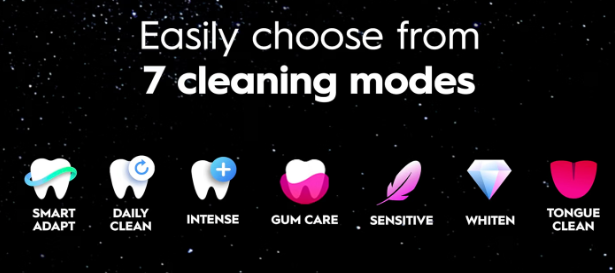
There is one complication, though: not every Oral-B iO toothbrush has the same modes. Oral-B itself notes that the number of settings varies by brush type, and different iO models offer different combinations. Some premium models provide seven brushing modes, while more affordable versions offer fewer.
So rather than treating the iO family as one toothbrush with seven universal settings, we’re going to look at what each mode means, when it makes sense, and whether changing modes actually matters.
How Many Modes Does an Oral-B iO Have?
The answer depends on which iO Series we own.
Across the Oral-B iO range, we can encounter modes including Daily Clean, Sensitive, Super Sensitive, Intense, Whiten, Gum Care, and Tongue Clean. Current Oral-B guidance also references Smart Adapt on certain higher-end models or markets.
Oral-B’s general iO guide states that all iO toothbrushes have at least three brushing modes, while specific settings are limited to certain models. For example, its guide identifies Gum Care as applying to selected models and Tongue Clean primarily to premium versions.
That means we shouldn’t buy an iO solely because we saw a particular mode mentioned in a general Oral-B advertisement.
Always check the specifications of the exact Series number and regional version we’re considering.
Oral-B iO Modes at a Glance
Here’s the simplest way to understand the major settings.
| Oral-B iO mode | Main purpose | Best suited to |
|---|---|---|
| Daily Clean | Normal everyday brushing | Most users |
| Sensitive | Gentler everyday brushing | Mild sensitivity |
| Super Sensitive | Extra-gentle brushing | Greater sensitivity or new electric-brush users |
| Intense | Stronger cleaning sensation | Users wanting a more vigorous clean |
| Whiten | Surface-stain polishing pattern | Coffee, tea, or similar surface stains |
| Gum Care | Gentler gumline-focused pattern | Users prioritizing gumline comfort |
| Tongue Clean | Short tongue-cleaning cycle | Finishing a brushing routine |
| Smart Adapt* | Automatically responds to brushing pressure | Users wanting adaptive assistance |
*Availability varies according to model and market.
The premium iO Series 10, for example, is currently described by Oral-B in the US as having seven smart brushing modes: Daily Clean, Whiten, Gum Care, Sensitive, Super Sensitive, Intense, and Tongue Clean.
1. Daily Clean Mode
If we don’t know which setting to use, Daily Clean is the obvious starting point.
Oral-B describes Daily Clean as its mode for everyday cleaning and plaque removal.
Think of it as the toothbrush’s standard gear. It isn’t trying to be particularly gentle, aggressive, specialized, or clever. It simply provides the normal brushing experience around which the rest of the modes are built.
For many people, Daily Clean could be the only mode they ever need.
When Should We Use Daily Clean?
Daily Clean makes sense for routine morning and evening brushing when our teeth and gums tolerate a standard electric toothbrush comfortably.
It’s especially useful when we’re becoming overwhelmed by mode selection. A toothbrush with six or seven settings can tempt us to switch constantly, yet consistency, technique, coverage, brushing time, and appropriate pressure remain more important than chasing the perfect icon on the display.
If our mouth feels comfortable with Daily Clean, there’s no rule saying we must rotate between all the other modes.
Is Daily Clean Strong Enough?
For normal brushing, yes.
A stronger-feeling setting isn’t automatically a better one. Plaque removal does not require us to attack our teeth like we’re pressure-washing a driveway.
The brush head needs time to work around each tooth while we maintain sensible pressure. That’s where the iO’s pressure feedback can be particularly helpful.
2. Sensitive Mode
Sensitive mode lowers the intensity to create a gentler brushing experience.
Oral-B describes the setting as using lower intensity or speed to clean enamel and gums more gently.
That’s useful because one common mistake when moving from a manual toothbrush to an electric model is assuming more force equals cleaner teeth.
It doesn’t.
With an electric toothbrush doing much of the movement itself, our job is mostly to guide it.
Who Should Try Sensitive Mode?
Sensitive is worth experimenting with when Daily Clean feels unnecessarily strong, particularly around the gumline.
It can also make the transition to an electric toothbrush less jarring.
The sensation of an iO brush can seem unusually powerful at first, even when we’re not brushing incorrectly. Dropping to Sensitive mode for a while lets us become accustomed to the movement before deciding whether we want more intensity.
It’s also a sensible everyday mode. We don’t have to “graduate” from Sensitive just because our toothbrush offers stronger settings.
Sensitive Mode Isn’t a Treatment for Tooth Sensitivity
This distinction matters.
Choosing Sensitive mode may make brushing more comfortable, but persistent tooth sensitivity can have many causes. Changing a toothbrush setting doesn’t diagnose or resolve those underlying issues.
If we repeatedly experience pain, sharp sensitivity, bleeding, swelling, or discomfort, that’s a reason to discuss it with a dental professional rather than simply continuing to lower the toothbrush intensity.
3. Super Sensitive Mode
What happens when Sensitive still feels like too much?
That’s where Super Sensitive enters the picture.
Oral-B describes Super Sensitive as an especially gentle setting for extra-sensitive areas, and its general iO guidance specifically suggests that people using an electric toothbrush for the first time can start with Super Sensitive where their model provides it.
The difference may sound minor on paper, but in the mouth it can be meaningful.
Sensitive vs Super Sensitive: What’s the Difference?
Both modes prioritize gentleness, but Super Sensitive sits further toward the soft end of the scale.
We can think of them like volume controls:
Daily Clean → Sensitive → Super Sensitive
We’re progressively turning down the intensity rather than changing the fundamental purpose of brushing.
That makes Super Sensitive particularly appealing when we’re getting accustomed to powered brushing or when certain areas feel uncomfortable at normal intensity.
However, the setting isn’t available across the entire iO lineup, so check the exact model rather than assuming an iO automatically includes it.
4. Intense Mode
If Super Sensitive whispers, Intense speaks more loudly.
Oral-B describes Intense as a mode designed to provide a more powerful cleaning experience and, depending on the guide or region, refers to harder-to-reach cleaning or increased intensity.
It gives brushing a stronger, more energetic feel.
And yes, some users love that sensation.
Does Intense Mode Clean Better?
This is where we need to separate feeling cleaner from necessarily being cleaner.
A stronger brushing sensation can make our mouth feel exceptionally polished, but that doesn’t mean we should automatically use Intense every time.
Good brushing still depends on covering the whole mouth, allowing the powered brush head to do its work, brushing for an appropriate amount of time, and avoiding excessive pressure.
If turning up the mode makes us instinctively press harder or rush through sensitive areas, we’ve defeated the purpose.
When Does Intense Make Sense?
Intense is best treated as an optional preference rather than a mandatory upgrade from Daily Clean.
If we enjoy a stronger sensation, our gums remain comfortable, and we’re not triggering pressure warnings, it may suit us nicely.
But there’s no medal for brushing at maximum intensity.
5. Whiten Mode
“Whiten” is probably the mode name that creates the biggest expectations.
We press the button and imagine our toothbrush transforming into a miniature professional whitening machine.
That’s not really what is happening.
Oral-B says its Whiten mode alternates intensities or speeds to help polish away surface stains.
Those last two words—surface stains—are important.
Does Oral-B iO Whitening Mode Actually Whiten Teeth?
It can help with the appearance of some external staining, but we shouldn’t confuse polishing with chemical bleaching.
Coffee, tea, tobacco, red wine, and strongly colored foods can contribute to external staining. A polishing-oriented brushing pattern may help remove some of that discoloration from tooth surfaces.
But toothbrush mode cannot fundamentally change the natural internal color of our teeth in the same way that peroxide-based whitening treatments can.
So Whiten mode is better understood as a surface-stain maintenance setting rather than a bleaching treatment.
Should We Use Whiten Every Day?
Follow the instructions supplied with our particular toothbrush and consider our own comfort level.
There’s little reason to obsess over running Whiten mode constantly if Daily Clean already leaves our teeth comfortable and clean.
The smartest mode isn’t necessarily the one with the most attractive name. It’s the one that encourages us to brush consistently and correctly.
6. Gum Care Mode
Gum Care sounds almost medical, but its role is much simpler.
Oral-B describes the setting as a gentle mode that massages or stimulates the gums while cleaning.
Its gentler pattern can feel pleasant along the gumline, particularly for users who dislike the more energetic sensation of Intense or standard brushing modes.
Gum Care vs Sensitive Mode
These two settings overlap somewhat in spirit: both lean toward gentleness.
Sensitive primarily reduces intensity to make brushing easier on sensitive teeth and gums, while Gum Care uses a gentler pattern intended specifically around gumline care.
In real-world use, preference matters.
One person’s ideal Gum Care mode may be another person’s Sensitive mode.
We don’t need to force a specific setting simply because its label appears to match our goal.
Can Gum Care Mode Fix Bleeding Gums?
No toothbrush mode should be treated as a diagnosis or cure.
Bleeding can sometimes occur when gums are inflamed, but it may also accompany other oral-health issues. If bleeding persists, becomes significant, or worries us, professional dental advice is more appropriate than experimenting indefinitely with toothbrush settings.
Gum Care can change the brushing experience. It doesn’t replace dental care.
7. Tongue Clean Mode
We’ve finished brushing our teeth. Why would the toothbrush need another setting?
Because our teeth aren’t the only surfaces in the mouth.
Oral-B’s Tongue Clean mode provides a brief cycle intended to gently clean the tongue and nearby oral surfaces. Current Oral-B guidance describes it as a short-duration setting and notes that its availability is restricted to certain premium iO models.
How Do We Use Tongue Clean Mode?
The trick is restraint.
Our tongue isn’t a kitchen countertop, so scrubbing it aggressively isn’t the goal.
We can lightly guide the brush across the accessible surface of the tongue, avoiding unnecessary force or pushing the brush so far back that we trigger our gag reflex.
Some people will still prefer a dedicated tongue scraper, and that’s perfectly reasonable.
The iO’s Tongue Clean mode is about convenience: finish the teeth, switch modes, clean the tongue, rinse, and move on.
8. Smart Adapt Mode
Smart Adapt is one of the more confusing names associated with the iO family because it doesn’t appear identically in every product description or market.
Current Oral-B guidance describes Smart Adapt as a setting that reacts dynamically to the pressure we apply, adjusting intensity to balance cleaning with gentleness. Oral-B’s UK guides specifically reference the feature on selected premium models.
Rather than asking us to manually decide whether we need maximum or minimum intensity, the idea is to let the brush respond to how we’re brushing.
Why Smart Adapt Is Different From Normal Modes
Most modes begin with us choosing a behavior:
“Be gentle.”
“Clean intensely.”
“Focus on whitening.”
Smart Adapt reverses the logic. The brush responds dynamically instead.
That potentially makes it useful for people who want a more automatic experience rather than continually worrying about intensity.
Because Oral-B’s current regional documentation isn’t completely uniform in how this feature is presented, verify its availability on the exact iO model sold in our country before making a purchase specifically for Smart Adapt.
How to Change Modes on an Oral-B iO
Mode switching is refreshingly straightforward on compatible iO models.
Oral-B’s general guidance says we can turn on the toothbrush with the power button and use the mode-selection control to cycle through the available settings. Models with displays make the selected mode easier to identify, while compatible versions can also integrate mode selection or personalization through the Oral-B app.
A typical routine looks like this:
- Turn on or wake the toothbrush.
- Use the mode-selection button to move through the available settings.
- Watch the handle display or mode indicator where provided.
- Stop when the preferred brushing mode appears.
- Brush normally while paying attention to pressure feedback.
- Use the Oral-B app for additional customization when supported by the model.
The exact interface differs among iO generations, particularly between simpler models and premium versions with interactive displays.
Which Oral-B iO Mode Is Best?
If we had to choose one setting for the average person, we’d start with Daily Clean.
That’s precisely what makes it Daily Clean.
But “best” changes depending on what we’re trying to achieve.
For a softer experience, try Sensitive. If that’s still uncomfortable and our model includes it, Super Sensitive goes another step down. If we prefer a more vigorous clean, Intense may feel better. Whiten focuses on surface-stain polishing, Gum Care offers a gentler gum-oriented experience, and Tongue Clean completes the routine away from the teeth.
The beauty of multiple modes isn’t that we need all of them.
It’s that we have options.
Best Mode for Everyday Brushing
For most people: Daily Clean.
It’s uncomplicated, balanced, and specifically designed for routine brushing.
Best Mode for Sensitive Teeth
Start with Sensitive, or consider Super Sensitive if our brush offers it and standard Sensitive mode still feels uncomfortable.
Again, recurring pain or pronounced sensitivity deserves professional attention.
Best Mode for Stained Teeth
Whiten is the most logical mode for external surface staining.
Just keep expectations grounded. We’re polishing away some superficial staining, not changing tooth color several shades through brushing alone.
Best Mode for Gums
Gum Care may be the most comfortable specialized option when available, although Sensitive can also provide a gentler experience.
Technique and pressure matter enormously here.
Do Oral-B iO Modes Change the Power?
They can alter the intensity and/or movement pattern, depending on the selected setting.
That’s why switching from Super Sensitive to Intense can feel dramatically different even though we’re using the same handle and brush head.
But power is only one part of the experience.
Whiten, for example, is characterized by alternating intensity or speed rather than simply turning everything up. Gum Care emphasizes a gentler pattern. Tongue Clean alters the routine in both purpose and duration.
So thinking of the settings as nothing more than “low, medium, and high” misses much of the point.
Oral-B iO Modes vs Pressure Sensor
This distinction is crucial.
Brushing mode determines how the toothbrush is programmed to operate.
Pressure feedback responds to how hard we’re physically pressing.
We can therefore choose a gentle mode and still brush too aggressively.
Premium iO models use visible pressure feedback to indicate whether brushing pressure is too high, too low, or appropriate.
That’s why technique continues to matter even when we’ve selected Sensitive or Gum Care.
The mode doesn’t give us permission to lean into the toothbrush.
Do We Need an Oral-B iO With Seven Modes?
Probably not.
But we might want one.
There’s a difference.
Someone who wants a premium display, connected coaching, multiple specialized brushing patterns, and extensive customization may appreciate having the full menu.
Someone who simply wants excellent powered brushing may spend most of the toothbrush’s life using Daily Clean and occasionally Sensitive.
That’s why mode count should be considered a convenience and personalization feature, not a scoreboard.
Seven isn’t automatically better than five for every person.
More Modes Can Still Be Useful
The advantage is flexibility.
Imagine two people sharing the same bathroom. One likes a strong morning clean, while the other finds powerful electric brushing uncomfortable. Multiple modes let each person tailor the experience without needing an entirely different brushing technology.
Likewise, our own preferences can change.
Maybe we normally use Daily Clean but prefer Sensitive after dental treatment once our dentist says routine brushing is appropriate. Perhaps we use Whiten periodically because we drink plenty of coffee. Or maybe Super Sensitive simply feels nicer first thing in the morning.
Choice is valuable even when we don’t use every option equally.
Common Mistakes When Using Oral-B iO Modes
The first mistake is assuming Intense must clean better because it feels stronger.
The second is believing Sensitive won’t clean properly because it feels gentler.
The third is expecting Whiten mode to bleach teeth.
And the fourth? Switching modes constantly while ignoring brushing fundamentals.
A fancy mode cannot compensate for repeatedly missing the back teeth, rushing through one side of the mouth, brushing for too little time, using worn bristles, or pressing too hard.
The mode is the seasoning.
Technique is still the meal.
Should We Switch Modes During the Same Brushing Session?
Usually, we don’t need to complicate things.
One appropriate mode for the main brushing session is perfectly reasonable. If our model has Tongue Clean, that naturally becomes a separate finishing step.
There may be situations where an individual prefers different intensities in different areas, but turning every brushing session into a complicated sequence of button presses defeats one of the best things about electric toothbrushes: consistency.
Choose a comfortable mode, guide the brush carefully, cover every area, and let the toothbrush do its job.
How to Choose the Right Oral-B iO Mode
If we’re unsure, Daily Clean provides the easiest baseline.
Use it for several brushing sessions and pay attention to how our mouth feels.
If the sensation is too strong, move toward Sensitive or Super Sensitive. If we genuinely prefer more intensity without needing extra pressure, experiment with Intense. If surface stains are our priority, Whiten is worth trying. Gum Care can provide a softer gum-focused alternative, while Tongue Clean is exactly what its name suggests.
Our ideal setting is the one we can use comfortably and consistently with good technique.
That’s much more important than finding the supposedly “strongest” mode.
Are Oral-B iO Modes Worth Paying Extra For?
This depends on how much we value personalization.
If we’re comparing two iO models and the major difference is extra brushing modes, ask ourselves a simple question:
Will we actually use them?
Someone with sensitivity may place real value on having both Sensitive and Super Sensitive. Someone focused on cosmetic surface staining may appreciate Whiten. Another buyer may care far more about the display, app tracking, charging system, accessories, or price.
Premium iO models package several features together, so we’re rarely paying only for additional modes.
The right decision isn’t necessarily to buy the brush with the longest specification sheet.
It’s to buy the one whose features match our routine.
Final Thoughts on Oral-B iO Different Modes
The Oral-B iO different modes sound complicated until we strip away the marketing names.
Daily Clean is the dependable everyday setting. Sensitive softens the experience. Super Sensitive makes it gentler still. Intense offers a stronger sensation. Whiten targets surface-stain polishing. Gum Care focuses on a gentler gumline experience. Tongue Clean provides a short finishing cycle for the tongue, while Smart Adapt, where available, takes a more dynamic approach to adjusting brushing intensity.
That’s really the whole story.
We don’t need to cycle through every mode simply because the toothbrush provides them. In fact, many of us will probably find one or two favorites and barely touch the rest.
And that’s fine.
A toothbrush mode is a tool, not a challenge to complete.
The most useful Oral-B iO setting is ultimately the one that helps us brush comfortably, thoroughly, consistently, and without excessive pressure.
Frequently Asked Questions
1. What are the different modes on an Oral-B iO toothbrush?
Depending on the exact iO model, available modes can include Daily Clean, Sensitive, Super Sensitive, Intense, Whiten, Gum Care, and Tongue Clean. Certain current Oral-B materials also reference Smart Adapt on selected premium models. Mode availability varies by Series and market, so check the specifications of the exact toothbrush rather than assuming every iO has every setting.
2. Which Oral-B iO mode should we use every day?
Daily Clean is the natural choice for regular everyday brushing because Oral-B specifically positions it as its standard plaque-removal and daily-cleaning setting. Sensitive can also work as an everyday option if we prefer a softer brushing sensation.
3. What is the difference between Sensitive and Super Sensitive on Oral-B iO?
Both reduce the intensity of the brushing experience, but Super Sensitive is designed to be gentler still. It’s particularly useful for people who find regular powered brushing intense or who are just getting accustomed to an electric toothbrush. Not every iO model includes Super Sensitive.
4. Does Oral-B iO Whiten mode really whiten teeth?
Whiten mode is designed to help polish away surface stains using alternating speeds or intensities. It shouldn’t be confused with chemical tooth bleaching, which can alter tooth color more substantially. Think of Whiten as a polishing-oriented maintenance mode rather than an in-home bleaching treatment.
5. Does every Oral-B iO have the same brushing modes?
No. The number and combination of modes vary across the Oral-B iO range. Oral-B’s own guidance explicitly notes that settings differ according to brush type, with certain modes reserved for selected Series models. Always verify the precise model specifications before buying if a particular mode is important to us.