
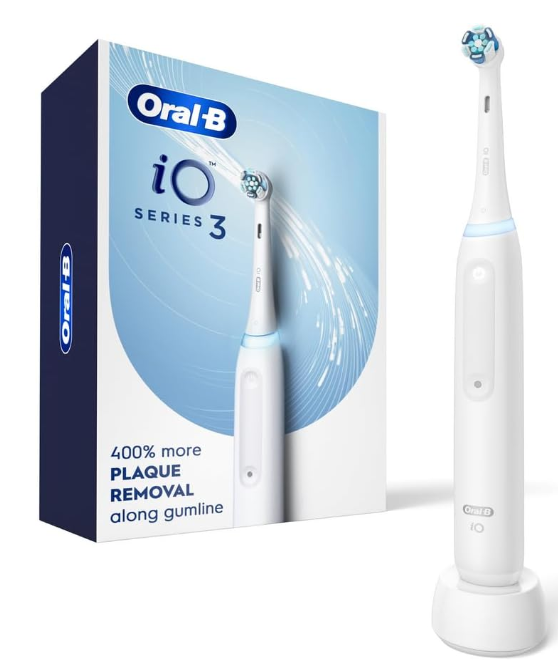
If you are considering the Oral-B iO3—or you already have one sitting beside the bathroom sink—one practical question matters more than many of the flashy features: how long will Oral-B iO3 last on one charge?
The short answer is reassuring. An Oral-B iO3 can last up to around four weeks on a full charge under typical brushing conditions, according to Oral-B’s current comparison information. That assumes roughly two brushing sessions per day and normal-length sessions.
Real life, however, rarely behaves like a specification sheet.
Some owners may see closer to two or three weeks between charges, particularly if they brush longer than two minutes, use the toothbrush more frequently, share the handle, or have an older battery. Oral-B itself notes more broadly that battery life across its iO range varies according to brushing frequency, brushing mode, and usage habits.
So rather than thinking of the battery as a stopwatch that always expires on day 28, it is better to picture it as a fuel tank. How far it takes us depends on how we drive.
Let’s look at what that means in everyday use.
How Long Will Oral-B iO3 Last on One Charge in Real Life?
For most people, a sensible expectation is roughly two to four weeks from a full Oral-B iO3 charge.
Current Oral-B information in the United States lists the iO3 at approximately four weeks of battery life.
At the same time, Oral-B’s broader guidance for its iO line states that many iO models are designed for approximately two weeks of use when brushing twice daily for two minutes, highlighting the fact that battery performance varies between models and conditions.
That apparent difference is exactly why we shouldn’t obsess over one magical number.
A newer iO3 being used for two short sessions each day may get remarkably close to the advertised maximum. A heavily used toothbrush might need its charger noticeably sooner.
The Simple Battery-Life Estimate
If we brush:
- twice per day,
- for approximately two minutes each time,
- with one person using the handle,
four weeks equals roughly 56 brushing sessions.
That works out to about 112 minutes of active brushing.
Of course, battery consumption does not depend solely on how many minutes the motor runs. Electronics, battery age, charging condition, pressure feedback, and other factors can influence actual endurance.
Still, 56 sessions gives us a useful mental benchmark.
Is Four Weeks of Oral-B iO3 Battery Life Realistic?
Yes, but we should interpret “four weeks” as an upper-end estimate rather than a guarantee that every iO3 will run for exactly 28 days.
Oral-B currently lists the iO3 at around four weeks in its comparison of electric toothbrushes under $100.
That’s impressive for a toothbrush with the iO magnetic drive system, pressure feedback, lighting, timers, and multiple brushing modes.
But imagine two owners.
One person brushes for exactly two minutes in the morning and two minutes at night.
Another loves that fresh-from-the-dentist feeling and brushes for three minutes after breakfast, three minutes before bed, and occasionally after lunch.
They’re using the same toothbrush, but their batteries are running two completely different races.
Why Some Oral-B iO3 Users Get Less Than Four Weeks
Several everyday behaviors can reduce the number of days between charges:
- Brushing for longer than two minutes
- Brushing more than twice daily
- Sharing the handle between two people
- Frequently turning the toothbrush on while rinsing or cleaning it
- Using a battery that has aged considerably
- Starting with something less than a full charge
- Leaving a stored toothbrush partially discharged for long periods
- Environmental and battery-condition differences
None of these automatically means anything is wrong with the toothbrush.
If we receive three weeks rather than exactly four, for example, the battery can still be functioning normally.
How Many Brushing Sessions Can the Oral-B iO3 Handle?
Let’s make the numbers easier to visualize.
If It Lasts Four Weeks
At two sessions per day:
28 days × 2 sessions = 56 brushing sessions
With each session lasting two minutes:
56 × 2 minutes = 112 minutes of brushing
If It Lasts Three Weeks
At the same routine:
21 days × 2 sessions = 42 sessions
That’s approximately:
84 minutes of active brushing
If It Lasts Two Weeks
We get:
14 days × 2 sessions = 28 sessions
Or:
56 minutes of active brushing
That range explains why two iO3 owners can report apparently different battery experiences while both toothbrushes are operating reasonably.
How Long Does the Oral-B iO3 Take to Charge?
Battery endurance is only half the story. Charging speed matters too.
The iO3 does not use the faster charging systems found on some higher-end iO models. Oral-B states that many rechargeable handles typically require roughly 12 to 18 hours to charge fully, while certain premium iO models such as the iO7, iO8, and iO9 use faster charging.
Depending on the specific iO3 handle and charger supplied in your market, a complete recharge can therefore feel more like an overnight event than plugging in a smartphone for half an hour.
That sounds inconvenient until we remember one thing: we usually aren’t charging every day.
If the toothbrush gives us several weeks of regular brushing, an overnight recharge every few weeks is hardly painful.
Should We Charge the Oral-B iO3 Overnight?
That’s usually the easiest approach.
Put the iO3 on its compatible charger before bed, leave it there overnight, and it should have a substantial charge ready for normal use.
For the most accurate charging instructions, however, we should follow the manual supplied with the specific handle and charger, since charging requirements can differ between Oral-B combinations. Oral-B specifically recommends checking the product instructions for model-specific charging information.
Can We Leave the Oral-B iO3 on the Charger?
This is one of the most common battery questions because many of us were taught that leaving rechargeable electronics plugged in would “cook” the battery.
Modern toothbrush charging is considerably more sophisticated.
Oral-B’s iO3 guidance states that we can keep the toothbrush on the charging base or remove it between charges and that the system is designed to avoid overcharging.
In other words, there is no need to leap out of bed at 3:00 a.m. because the toothbrush might have finished charging.
Is It Better to Charge Only When Necessary?
For everyday convenience, either approach can work.
Some people like to keep the charger permanently on the bathroom counter. Others prefer running the battery for several weeks and charging only when the indicator tells them power is running low.
Oral-B also recommends periodically allowing rechargeable toothbrushes to discharge as part of long-term battery maintenance guidance.
We don’t need to micromanage the battery every morning. Good charging habits should feel effortless, not like caring for a Formula One engine.
How Do We Know When the Oral-B iO3 Battery Is Low?
The iO3 includes battery-status feedback rather than leaving us completely in the dark.
Its handle can indicate when battery power is getting low, allowing us to recharge before the toothbrush suddenly stops halfway through brushing. Oral-B’s product information specifically notes that the iO3 display area can signal low battery status.
That’s particularly useful while travelling.
Nobody wants to discover at 6:30 a.m. in a hotel bathroom that their electric toothbrush has become a very expensive manual toothbrush.
Should We Wait Until the Battery Is Completely Empty?
Not necessarily before every recharge.
Lithium-ion rechargeable devices don’t require us to perform a complete discharge cycle every single time.
For normal use, charging when the battery becomes low is perfectly practical.
Oral-B’s broader battery-care guidance suggests occasionally allowing the handle to discharge fully rather than requiring that behavior after every charge.
Does Brushing Mode Affect Oral-B iO3 Battery Life?
Potentially, yes.
The iO3 offers three brushing modes, commonly including Daily Clean, Sensitive, and Whitening, although names or configurations can vary by market.
Different operating patterns can influence power consumption slightly.
But we wouldn’t expect switching modes once in a while to suddenly cut the battery from several weeks to several days.
The much bigger factor is usually total operating time.
If Whitening mode encourages us to brush longer, for instance, the longer session matters more than the word “Whitening” itself.
Daily Clean
This is the straightforward everyday option. If we brush for around two minutes twice daily, it provides a good baseline for estimating battery longevity.
Sensitive Mode
Sensitive mode is intended for gentler brushing. Actual battery savings, if any, shouldn’t be treated as a major reason to select it. We should choose a mode based primarily on brushing comfort and oral-care needs.
Whitening Mode
Whitening mode focuses on polishing away surface staining as part of the brushing routine.
Again, session length matters. Three-minute sessions consume more energy than two-minute sessions regardless of what they’re called.
Does the Pressure Sensor Use Much Battery?
The Oral-B iO3’s visible pressure sensor is one of the reasons people choose it over simpler electric toothbrushes.
The ring provides feedback while we brush, helping indicate whether our pressure is appropriate. Oral-B describes the iO3’s sensor as showing different feedback when pressure is too low, appropriate, or excessive.
That lighting system uses electricity, obviously, but it isn’t something we should worry about disabling to squeeze another day from the battery.
It’s part of the toothbrush’s normal operating design.
Trying to save power by ignoring useful brushing feedback would be like turning off a car’s dashboard just to preserve the 12-volt battery.
How Does Battery Age Affect the Oral-B iO3?
Rechargeable batteries don’t remain young forever.
When an iO3 is new, its battery should hold substantially more energy than one that has been heavily used for years.
Gradual capacity loss is normal for rechargeable batteries. Eventually, we may notice that a toothbrush which once went several weeks between charges now needs power more frequently.
What Is Normal Battery Aging?
A gradual reduction over a long period is different from sudden battery failure.
For example:
- New toothbrush: several weeks per charge
- Older toothbrush: noticeably fewer days
- Very old or degraded battery: frequent charging
Those examples aren’t fixed milestones, but they illustrate the pattern.
Battery deterioration tends to resemble a slowly shrinking fuel tank rather than a switch suddenly being flipped.
Why Is My Oral-B iO3 Battery Draining So Fast?
Suppose your toothbrush once lasted weeks but suddenly requires charging every few days.
That’s worth investigating.
Check Your Brushing Routine First
Before assuming the battery is faulty, ask:
- Are two people now using the handle?
- Have we started brushing longer?
- Are we brushing three times daily instead of twice?
- Was the toothbrush actually charged fully?
- Has the charger recently been unplugged or moved?
Simple changes often explain what looks like a battery problem.
Check the Charger and Power Source
Make sure the charging unit is connected properly and that the socket actually has power.
Bathroom outlets with switches or safety systems can occasionally create confusion.
A toothbrush sitting beautifully on an unpowered charger is still an uncharged toothbrush.
Clean and Dry the Charging Area
Residue and moisture can accumulate around bathroom accessories.
Oral-B recommends cleaning the toothbrush and charger appropriately and avoiding complete submersion of the charger.
Keeping the charging area clean is good practice for both hygiene and reliable daily use.
Consider the Age of the Handle
If the iO3 is several years old and battery life has steadily deteriorated, battery aging becomes a more plausible explanation.
If the change is dramatic or the toothbrush refuses to charge normally, consult Oral-B support or the warranty information applicable in your country.
How Can We Make an Oral-B iO3 Charge Last Longer?
We don’t need complicated tricks.
The most effective approach is surprisingly boring—which is good news.
1. Brush for the Recommended Amount of Time
Two minutes twice daily is a common routine and also the basis Oral-B uses when discussing battery estimates across many rechargeable toothbrushes.
If we routinely brush for four or five minutes, we should expect fewer calendar days from every charge.
2. Turn It Off When You’re Finished
Don’t leave the handle buzzing while searching for floss, rinsing the sink, or walking around the bathroom.
A few extra seconds won’t destroy the battery, but unnecessary motor time adds up.
3. Start Trips With a Full Charge
If we’re travelling for a week or two, fully charging the iO3 before departure can often eliminate the need to pack the charging base at all.
That’s one of the biggest advantages of multi-week battery life.
4. Don’t Panic-Charge Every Day
The iO3 doesn’t need to behave like a smartphone.
If battery life is healthy, we can simply use it normally and recharge when required.
5. Follow Oral-B’s Long-Term Battery Guidance
Oral-B recommends periodic discharge as part of maintaining rechargeable battery capacity.
There’s no reason to turn this into a complicated calendar ritual, but occasional normal discharge can be incorporated easily.
Is the Oral-B iO3 Good for Travel Without a Charger?
Absolutely—especially for shorter trips.
If your iO3 normally approaches several weeks per full charge, a weekend break is nothing.
A seven-day holiday shouldn’t make the battery break a sweat.
Even two weeks can be realistic without the charger if the handle is healthy and fully charged before departure.
For a Weekend Trip
Leave the charger at home.
A fully charged iO3 should have vastly more battery capacity than needed for four or six standard brushing sessions.
For a One-Week Holiday
Again, we would normally be comfortable travelling without the charger if the battery started near full.
For Two Weeks
A healthy battery should generally make this realistic under normal twice-daily use.
If your particular iO3 historically lasts only around two weeks, though, charge it immediately before leaving.
For Three to Four Weeks
Now we’d pack the charger unless we already know from experience that our own iO3 reliably reaches the upper end of its battery range.
Specifications are useful. Personal experience with the actual handle is better.
Can Two People Share One Oral-B iO3 Handle?
Technically, separate brush heads can allow multiple household members to use the same compatible handle, but battery life will drop much faster because the motor runs more often.
Let’s say one person uses the iO3 twice per day.
That’s four minutes of brushing daily.
Now two people use the same handle twice each.
We’ve doubled active brushing to around eight minutes daily.
A toothbrush that might last weeks for one person could therefore require charging much sooner when shared.
Battery life measured in days becomes misleading.
Battery life measured in brushing sessions makes much more sense.
Oral-B iO3 Battery Life vs Convenience
Battery specifications sound impressive, but the bigger question is whether the iO3 feels annoying to own.
In our view, the practical answer is no.
Even if we experience closer to two or three weeks rather than the maximum four-week figure, that’s still enough endurance that charging doesn’t dominate the routine.
Compare that with devices we charge constantly:
Phones? Daily.
Smartwatches? Often every few days.
Wireless earbuds? Regularly.
An electric toothbrush that asks for power only every few weeks is almost invisible by comparison.
Does the Oral-B iO3 Need to Be Fully Charged Before First Use?
Following the manufacturer’s instructions for the first full charge is a sensible move.
A complete initial charge gives us a clean starting point and makes it much easier to judge how long our particular toothbrush actually lasts.
Otherwise, we might open the box, use whatever factory charge remains, and conclude that the battery is poor when it simply wasn’t full.
A Simple Battery Test We Can Do at Home
Want to know how good your own Oral-B iO3 battery really is?
Try this:
- Fully charge the toothbrush.
- Note the date.
- Brush normally.
- Avoid topping it up between uses.
- Record when the low-battery warning appears.
- Count your brushing sessions.
That gives us something much more useful than arguing about theoretical specifications: the real battery endurance of our individual handle.
Repeat the experiment several months later if you’re curious about battery aging.
When Should We Worry About Oral-B iO3 Battery Life?
Battery life varying by several days isn’t automatically a problem.
We’d pay more attention if:
- A fully charged iO3 lasts only a handful of brushing sessions.
- The toothbrush suddenly loses most of its charge.
- It won’t charge despite being correctly positioned.
- The battery indicator behaves abnormally.
- Runtime deteriorates dramatically over a short period.
- The handle repeatedly stops during normal brushing.
Oral-B has troubleshooting guidance for handles that won’t hold a charge and recommends checking the correct charging requirements for the specific handle-and-charger combination.
When a relatively new toothbrush behaves like it needs life support every two days, something deserves investigation.
How Long Will Oral-B iO3 Last on One Charge Compared With What We Actually Need?
This may be the most useful way to think about the entire question.
We don’t truly need a toothbrush to last 30, 40, or 60 days.
We need it to last long enough that charging isn’t inconvenient.
For a person brushing twice per day, even two weeks represents around 28 sessions.
Three weeks gives about 42.
Four weeks gives roughly 56.
That’s already enough to cover most vacations, business trips, family visits, and ordinary stretches between charges.
The difference between 21 and 28 days looks enormous in a comparison table.
In the bathroom?
It’s basically the difference between putting the toothbrush on its charger this Sunday or next Sunday.
Suddenly, it doesn’t sound quite so dramatic.
Final Thoughts: How Long Does an Oral-B iO3 Battery Really Last?
So, how long will Oral-B iO3 last on one charge?
Current Oral-B comparison information lists the iO3 at approximately four weeks of battery life, while broader Oral-B guidance makes clear that actual endurance varies with brushing frequency, session length, usage patterns, and model conditions.
For everyday planning, we’d regard roughly two to four weeks per full charge as a useful expectation, with the upper end most achievable when one person brushes approximately twice daily for around two minutes.
The important part isn’t whether our toothbrush hits day 24, 25, or 28.
It’s consistency.
A healthy iO3 should give us enough breathing room that charging becomes an occasional chore rather than part of the daily routine.
And that’s ultimately what good battery life should feel like: not something we’re constantly thinking about, but something quietly doing its job in the background.
Frequently Asked Questions
1. How many days does the Oral-B iO3 last on one charge?
Oral-B currently lists the iO3 at approximately four weeks of battery life under typical use conditions. Actual runtime can be shorter depending on how frequently and how long we brush. For practical planning, somewhere around two to four weeks is a reasonable range rather than assuming every handle will always reach exactly 28 days.
2. How many times can you brush with an Oral-B iO3 before charging it?
If the toothbrush reaches four weeks of battery life and is used twice daily, that equals approximately 56 brushing sessions. Someone brushing more frequently or for longer periods will naturally get fewer days from the same charge.
3. Can I take the Oral-B iO3 on vacation without its charger?
For a weekend or one-week trip, a fully charged iO3 should normally provide plenty of power. Two-week travel without a charger can also be realistic with a healthy battery. For trips approaching three or four weeks, bringing the charger is safer unless you already know your particular handle reliably lasts that long.
4. Is it okay to leave the Oral-B iO3 on the charger all the time?
Oral-B says the iO3 can be kept on its charger or removed between charges and that its charging system is designed to prevent overcharging. That means leaving it on the compatible charging base is generally convenient rather than something we need to constantly worry about.
5. Why does my Oral-B iO3 battery not last as long as expected?
Shorter runtime can result from longer brushing sessions, more than two sessions per day, multiple people sharing the handle, an incomplete charge, or normal battery aging. If a fully charged toothbrush suddenly lasts only a few sessions or stops charging normally, check the charger and power source and consult Oral-B’s troubleshooting or warranty support if the problem continues.